SECTION A [20 MARKS]
Answer all the questions in this section.
A1
A1 Eating food in the laboratory is not allowed because the …
A food may be contaminated by germs
B food may be contaminated by harmful chemicals
C food will react with gaseous chemicals and explode
D learners may lose concentration
Answer: B. Laboratory benches and hands can carry traces of toxic chemicals, which could be swallowed with the food.
A2
A2 Which branch of chemistry studies the chemical composition of matter in a sample?
A analytical chemistry
B biochemistry
C inorganic chemistry
D physical chemistry
Answer: A (analytical chemistry). Analytical chemistry identifies what substances are present and how much of each.
A3
A3 The graph shows a heating curve. Which statement about the states of matter is correct?
A (i) is solid and liquid
B (ii) is solid and liquid
C (iii) is liquid only
D (iv) is liquid and gas
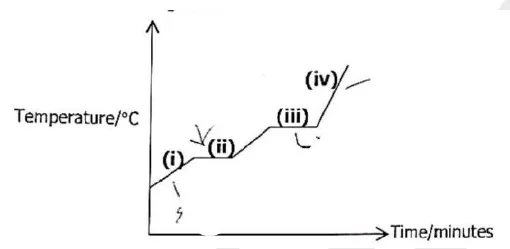
Answer: B. Section (ii) is the first flat part: the substance is melting, so solid and liquid are both present while the temperature stays constant. (i) is solid only and (iii) is the boiling plateau (liquid and gas).
A4
A4 The diagram shows some apparatus used in the school laboratory. The correct list of apparatus that can be used to separate a mixture of water and alcohol is …
A 1, 2, 3, 4 and 5.
B 1, 3, 4 and 5.
C 1, 4 and 5.
D 1, 2 and 4.
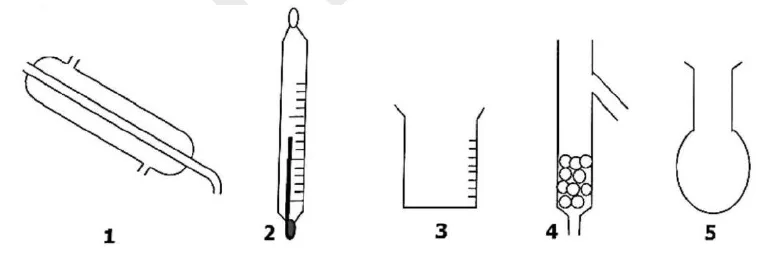
Answer: A (1, 2, 3, 4 and 5). Water and alcohol are miscible liquids with different boiling points, so they are separated by fractional distillation. This needs the round-bottomed flask (5), fractionating column (4), thermometer (2), condenser (1) and a beaker to collect the distillate (3).
A5
A5 The best way to obtain salt from a mixture of sand and salt is to add water, then …
A filter and warm the filtrate
B filter, warm and decant
C stir, filter and evaporate the water
D stir, filter, warm and cool the filtrate
Answer: C. Stirring dissolves the salt, filtering removes the insoluble sand, and evaporating the filtrate leaves the salt behind.
A6
A6 The chemical properties of an element are determined by the …
A nucleon number
B number of electrons in the outermost shell
C number of neutrons
D proton number
Answer: B. Reactions involve the outer-shell (valence) electrons being lost, gained or shared.
A7
A7 After losing three electrons, an element with 37 neutrons has 28 electrons. What is its relative atomic mass?
A 59
B 62
C 65
D 68
Answer: D (68). The neutral atom had electrons, so it has 31 protons. Mass number .
A8
A8 What is the electronic configuration of an aluminium ion, Al³⁺?
A 2.8.8
B 2.8.6
C 2.8.3
D 2.8
Answer: D (2.8). An aluminium atom is 2.8.3; losing its three outer electrons leaves 2.8.
A9
A9 Which is an acidic salt?
A NH₄Cl
B NaHSO₄
C NaNH₄SO₄
D CuSO₄
Answer: B (NaHSO₄). An acidic salt still contains a replaceable hydrogen from the acid; here only part of the H in H₂SO₄ has been replaced by sodium.
A10
A10 Phosphoric acid is a weak acid because it …
A does not react with metals
B does not react vigorously
C does not ionise completely in water
D is an organic acid
Answer: C. “Weak” describes how much an acid ionises, not how concentrated it is.
A11
A11 How many tonnes of sodium hydroxide exactly neutralise 7.3 tonnes of hydrochloric acid?
A 8.0
B 6.7
C 2.0
D 1.9
Answer: A (8.0 tonnes). reacts 1 : 1, so 40 g of NaOH reacts with 36.5 g of HCl:
A12
A12 What mass of zinc nitrate, Zn(NO₃)₂, is in 750 cm³ of a 0.25 M solution?
A 141.75 g
B 63.00 g
C 47.25 g
D 35.44 g
Answer: D (35.44 g). Moles mol. . Mass g.
A13
A13 Which condition will not affect the rate of a reaction between solid reactants?
A density
B particle size
C pressure
D temperature
Answer: C (pressure). Pressure changes the rate only when gases react, because it changes how closely the gas particles are packed. For solids, particle size (surface area) and temperature are the factors that matter.
A14
A14 Which element (neutrons, protons) is in Group IV and Period 3?
A 12, 12
B 16, 14
C 19, 16
D 20, 17
Answer: B. 14 protons gives the configuration 2.8.4: three shells (Period 3) and four outer electrons (Group IV). This is silicon.
A15
A15 Which two properties increase across a period from left to right? 1 metallic character, 2 number of electron shells, 3 total number of electrons, 4 number of protons
A 1 and 2
B 1 and 3
C 2 and 4
D 3 and 4
Answer: D (3 and 4). Each element has one more proton and one more electron than the one before. Metallic character decreases, and the number of shells stays the same across a period.
A16
A16 The diagram shows the structure of a metal. Which statement correctly describes the metal? The metal …
A has been made softer and weaker.
B has impurities that need to be purified.
C is made stronger because it has been alloyed.
D is stronger because it has been galvanised.
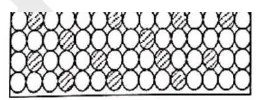
Answer: C (it is stronger because it has been alloyed). The atoms of a different size disrupt the regular layers, so the layers cannot slide over each other easily. This makes an alloy harder and stronger than the pure metal.
A17
A17 Hydrogen is prepared from zinc granules, dilute hydrochloric acid and aqueous copper(II) sulphate. What remains in the test tube if all the reactants are used up?
A zinc chloride, water and copper(II) sulphate
B zinc chloride, zinc sulphate, water and hydrogen gas
C zinc chloride and copper(II) sulphate
D zinc chloride and water
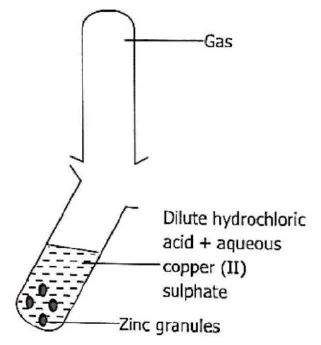
Answer: B. Zinc reacts with the acid: . Zinc also displaces copper from the copper(II) sulphate: . If every reactant is used up, the tube contains zinc chloride and zinc sulphate in water (with a little copper metal), while the hydrogen produced bubbles off.
A18
A18 Flowers are grown commercially in the structure shown. What is the effect on the environment outside the structure?
A environmental degradation
B global warming
C soil erosion
D ozone layer depletion
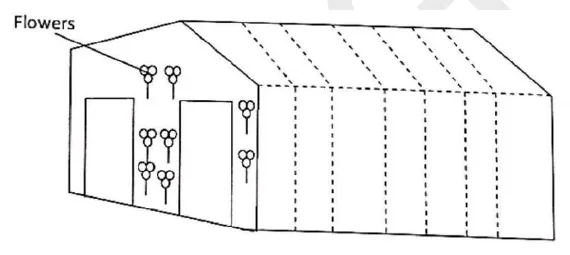
Answer: B (global warming). A greenhouse traps heat in the same way that greenhouse gases trap heat in the atmosphere. The heating and energy used to run large greenhouses add carbon dioxide to the air, contributing to global warming.
A19
A19 The structure belongs to a homologous series. What is the general formula of the series?
A CₙH₂ₙ
B CₙH₂ₙ₊₁
C CₙH₂ₙ₊₂
D CₙH₂ₙ₋₁
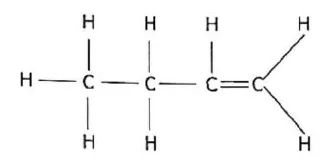
Answer: A (CₙH₂ₙ). The C=C double bond makes it an alkene (but-1-ene, C₄H₈). Alkenes have the general formula CₙH₂ₙ; alkanes are CₙH₂ₙ₊₂.
A20
A20 Which structure has a peptide link?
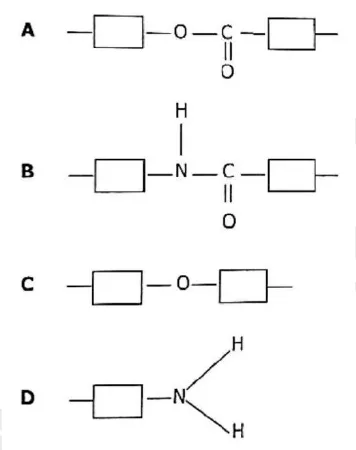
Answer: B. The peptide (amide) link is –CO–NH–, which joins amino acids in proteins. Structure A is an ester link, found in polyesters and fats.
SECTION B [45 MARKS]
Answer all questions in this section.
B1
B1 Substance X melts at −8 °C and boils at 65 °C.
(a) Draw the arrangement of particles of X at (i) −10 °C, (ii) 100 °C, (iii) 0 °C. [3]
(b) State what happens to the temperature while X is melting, and explain. [2]
(a) At −10 °C X is a solid (below its melting point); at 100 °C it is a gas (above its boiling point); at 0 °C it is a liquid.
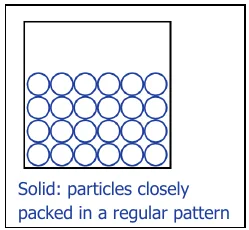
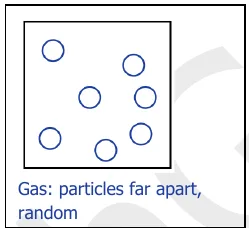
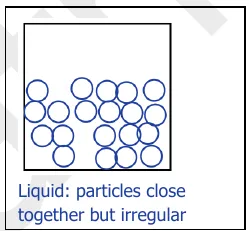
(b) The temperature stays constant at −8 °C. The heat energy supplied (latent heat) is used to break the forces of attraction between the particles instead of raising the temperature.
B2
B2 The diagrams show methods of separating substances.
(a) Name techniques A, B and C. [3]
(b)(i) Suggest a substance that can be separated by technique A. [1] (ii) Explain why substance Y may not be pure. [1]
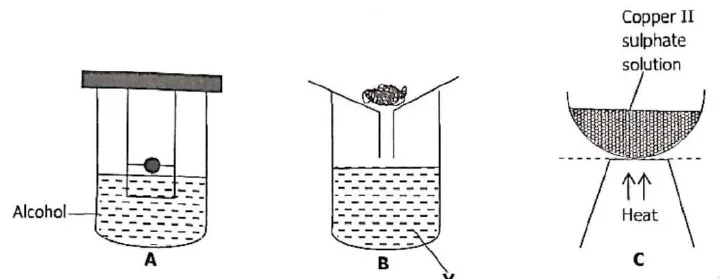
(a) A: chromatography. B: filtration. C: evaporation (crystallisation).
(b)(i) Ink (its coloured dyes) or plant pigments such as chlorophyll.
(b)(ii) Any soluble impurities pass through the filter paper with the filtrate, so Y may still contain dissolved substances.
B3
B3 Element W is 2, 8, 3 and element Z is 2, 8, 7.
(a) State one physical property of (i) W, [1] (ii) Z. [1]
(b) Write a balanced equation for the reaction between W and Z. [2]
(c) State one physical property of the compound formed. [1]
W is aluminium (Group III) and Z is chlorine (Group VII).
(a)(i) W is a shiny, malleable metal and a good conductor of electricity.
(a)(ii) Z is a greenish-yellow gas at room temperature and a poor conductor.
(b) W forms W³⁺ ions and Z forms Z⁻ ions, so the compound is WZ₃:
(c) It is a white solid that sublimes on heating (and it dissolves in water).
B4
B4 Hydrated zinc sulphate, ZnSO₄·XH₂O, is heated to constant mass. Mass of empty tube = 74.25 g; tube + hydrated salt = 77.97 g; tube + salt after the fourth heating = 76.34 g.
(a) Name a zinc compound that reacts with dilute sulphuric acid to make zinc sulphate. [1]
(b) Why was the tube heated, cooled and reweighed four times? [1]
(c) Calculate the moles of (i) anhydrous salt, [2] (ii) water driven off. [1]
(d) Find X. [1]
(a) Zinc oxide (or zinc carbonate, or zinc hydroxide).
(b) To make sure all the water of crystallisation had been driven off: heating is repeated until the mass stops changing (constant mass).
(c)(i) Mass of ZnSO₄ g. .
(c)(ii) Mass of water g.
(d) Ratio ZnSO₄ : H₂O . X = 7, so the formula is ZnSO₄·7H₂O.
B5
B5 (a) Define the rate of a chemical reaction. [1]
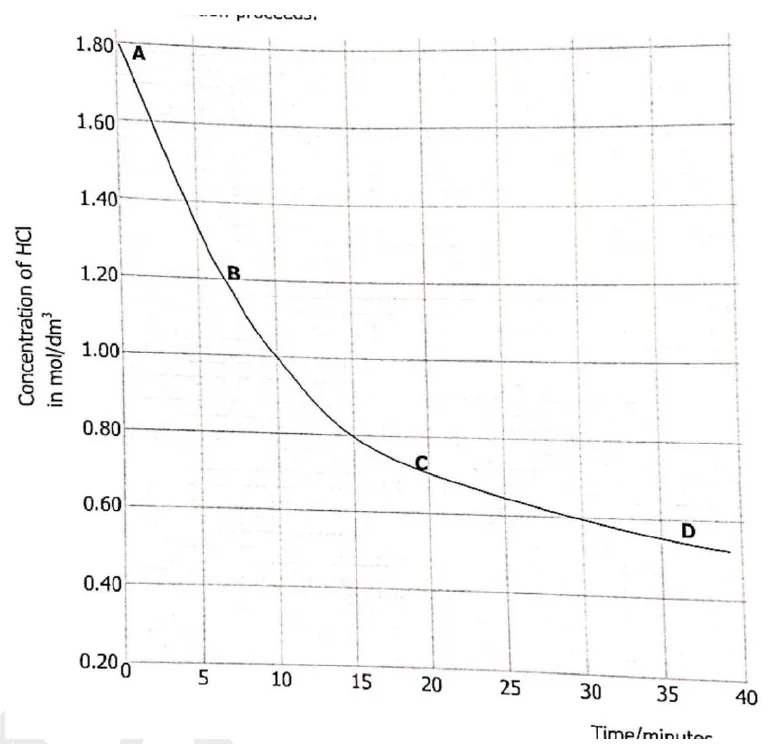
(b) The graph shows how the concentration of hydrochloric acid changes during a reaction. (i) Find the concentration after 4 minutes. [1] (ii) At which point, A, B, C or D, is the rate fastest, and why? [2]
(a) The change in the amount (concentration) of a reactant or product per unit time.
(b)(i) Reading up from 4 minutes: about 1.40 mol/dm³.
(b)(ii) Point A. The curve is steepest there, because the acid is most concentrated at the start, so particles collide most frequently.
B6
B6 The table gives the oxides of the Period 3 elements: Na₂O, MgO, Al₂O₃, SiO₂, P₂O₅, SO₃, Cl₂O and none for Group VIII.
(a) What is the valency of silicon? [1]
(b) Name (i) an amphoteric oxide, [1] (ii) a basic oxide. [1]
(c) Explain why Group VIII elements do not form oxides. [1]
(a) 4 (from SiO₂: each O has valency 2, so Si has 4).
(b)(i) Aluminium oxide, Al₂O₃, which reacts with both acids and bases.
(b)(ii) Sodium oxide (or magnesium oxide).
(c) Noble gas atoms have a full, stable outer shell of electrons, so they do not lose, gain or share electrons and are unreactive.
B7
B7 (a) State the approximate percentages of nitrogen and oxygen in dry air. [2]
(b) What are isotopes? [1]
(c) Give one use each of oxygen and argon. [2]
(a) Nitrogen 78%, oxygen 21%.
(b) Atoms of the same element with the same number of protons but different numbers of neutrons (so different mass numbers).
(c) Oxygen: breathing support in hospitals (or welding and steel making). Argon: filling electric light bulbs (an unreactive atmosphere).
B8
B8 The apparatus was left undisturbed for a week.
(a)(i) Which two observations were made after seven days? [2] (ii) State two conditions responsible. [2]
(b) Give one way to prevent this undesirable result, and justify it. [2]
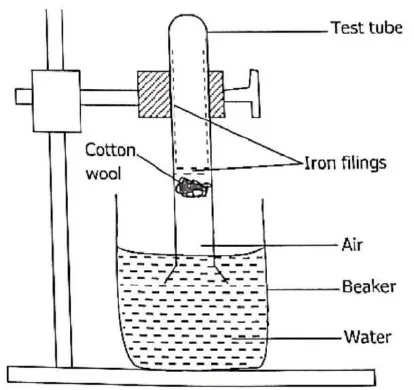
(a)(i)
- The iron filings rusted (turned reddish-brown).
- The water level rose inside the test tube, because the oxygen in the trapped air was used up (by about one fifth).
(a)(ii) Water (moisture) and oxygen (air).
(b) Paint, oil or galvanise the iron. This forms a barrier that stops oxygen and water reaching the iron surface, so it cannot rust.
B9
B9 Glycolic acid (structure shown) is a solid at room temperature and pressure.
(a) Describe the forces between its molecules and their motion. [2]
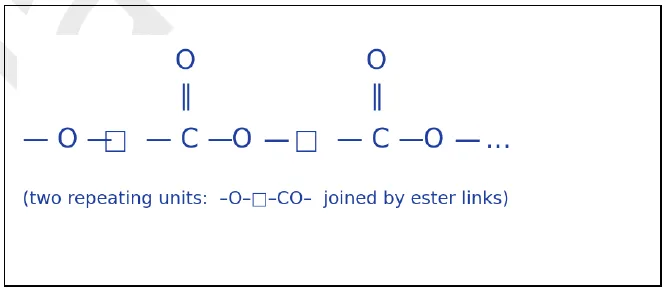
(b) Glycolic acid polymerises to form poly(glycolic acid), a polyester. (i) What type of polymer is a polyester? [1] (ii) Draw a section of the polymer with at least two repeating units. [2]
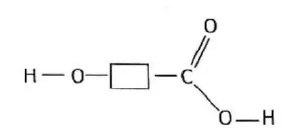
(a) Forces: strong forces of attraction hold the molecules close together in fixed positions. Motion: the molecules only vibrate about fixed positions.
(b)(i) A condensation polymer: each ester link forms with the loss of a small molecule (water).
(b)(ii)
SECTION C [20 MARKS]
Answer any two (2) questions from this section.
C1
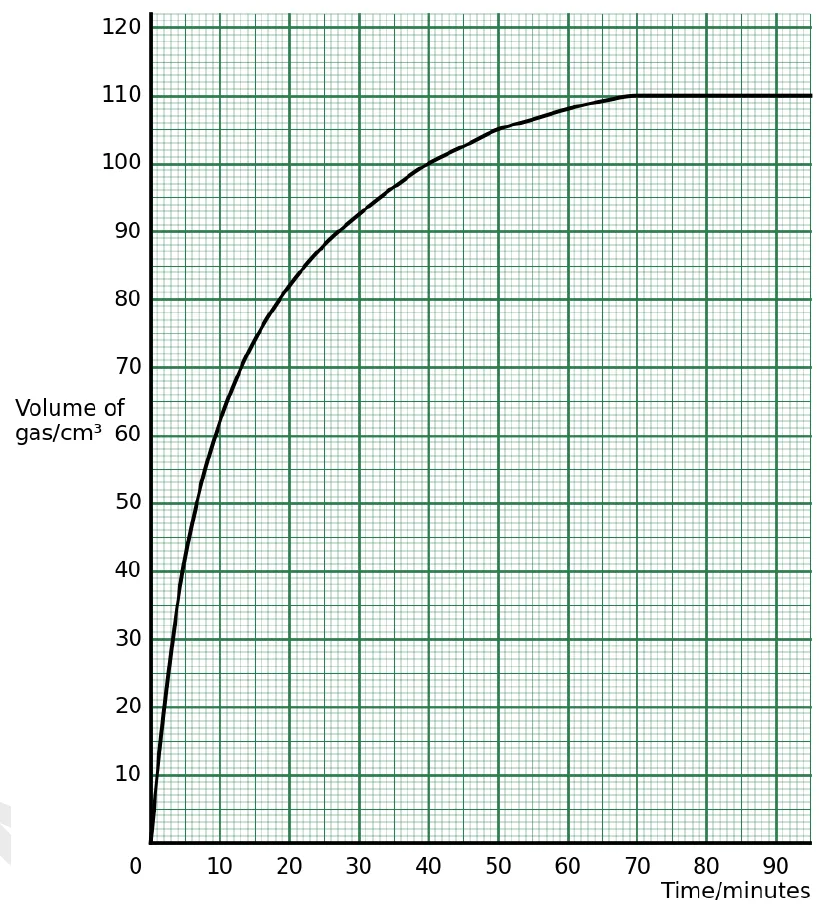
The graph shows the volume of gas collected over time from dilute hydrochloric acid and sodium carbonate at room temperature and pressure.
(a)(i) Write a balanced equation with state symbols. [3] (ii) How long did the reaction take to finish? [1] (iii) Calculate the amount of sodium carbonate that reacted. [3] (iv) What volume had been collected after 25 minutes? [1]
(b) The gas is collected over water instead. (i) Why might this not be the best method? [1] (ii) Suggest the best method. [1]
(a)(i)
(a)(ii) About 70 minutes: after that, the volume stays constant at 110 cm³.
(a)(iii) At room temperature and pressure, 1 mole of gas occupies 24 000 cm³:
The ratio Na₂CO₃ : CO₂ is 1 : 1, so 0.00458 mol of sodium carbonate reacted (mass g).
(a)(iv) About 88 cm³ (read up from 25 minutes).
(b)(i) Carbon dioxide is slightly soluble in water, so some dissolves and a smaller volume is collected.
(b)(ii) Use a gas syringe (or downward delivery, since carbon dioxide is denser than air).
C2
| Acid | Formula | Density | Melting point (°C) |
|---|---|---|---|
| Methanoic | HCOOH | 1.22 | 8 |
| Ethanoic | CH₃COOH | 1.05 | 17 |
| Propanoic | CH₃CH₂COOH | 0.99 | −21 |
| Butanoic | CH₃(CH₂)₂COOH | 0.96 | −4 |
(a)(i) What is the trend in density as the number of carbon atoms increases? [1] (ii) Which acid is a liquid at room temperature? [1]
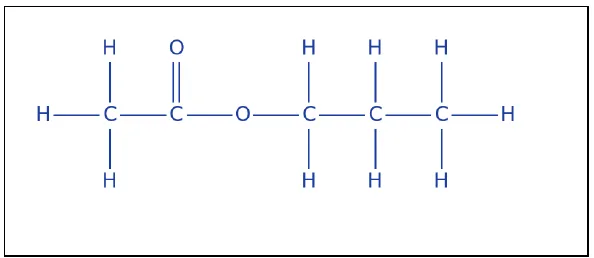
(b) Propanol reacts with ethanoic acid to form an ester. (i) What is a strong acid? [1] (ii) Name and draw the displayed structure of the ester. [2]
(c) State the reagent and conditions to oxidise propanol to propanoic acid. [2]
(d) Concentrated ethanoic acid reacts with calcium to give calcium ethanoate and hydrogen. (i) Write the equation. [1] (ii) How does the rate change with dilute ethanoic acid? Explain. [2]
(a)(i) The density decreases as the number of carbon atoms increases.
(a)(ii) Propanoic acid (melting point −21 °C). In fact all four melt below room temperature (about 25 °C), so all four are liquids; propanoic acid has the lowest melting point.
(b)(i) A strong acid ionises completely in water.
(b)(ii) Propyl ethanoate:
(c) Reagent: acidified potassium dichromate(VI) (or acidified potassium manganate(VII)). Condition: heat under reflux.
(d)(i)
(d)(ii) The rate decreases. Dilute acid has fewer H⁺ ions per unit volume, so there are fewer collisions per second with the calcium.
C3
(a) Explain why metals (i) are malleable, (ii) have high density. [2]
(b) Why is magnesium oxide used as a refractory material in furnaces? [2]
(c) Magnesium reacts with chlorine to form magnesium chloride. (i) Write a balanced equation. [2] (ii) Suggest one way to increase the rate. [1] (iii) Calculate the moles of sodium hydroxide in 250 cm³ of the sodium hydroxide solution. [2]
(d) Why are metals recycled? [1]
(a)(i) The layers of metal ions can slide over each other without the metallic bonds breaking.
(a)(ii) The metal atoms are very closely packed.
(b) Magnesium oxide has a very high melting point (about 2 800 °C), so it does not melt at furnace temperatures.
(c)(i)
(c)(ii) Heat the magnesium, or use magnesium powder (larger surface area).
(c)(iii) The printed question does not give the concentration of the solution. The method is: moles concentration (mol/dm³) volume (dm³) concentration concentration . For example, a 0.1 mol/dm³ solution would contain mol.
(d) To conserve metal ores, save energy and reduce waste and pollution.
Keep practising
Try another paper under timed conditions, then check your work against the solutions.