SECTION A [40 MARKS]
Answer all questions in this section.
Question 1
Figure 1 shows a farmer turning a heap of plant manure.
(a)(i) Identify the type of plant manure. [1] (ii) Why does the farmer turn the heap? [1]
(b) Describe organic manure. [2]
(c) How would a farmer use organic manure in a maize field? [2]
(d)(i) What is the benefit of supplementing nitrogen in the soil? [1] (ii) Explain the advantage of conservation farming. [1]
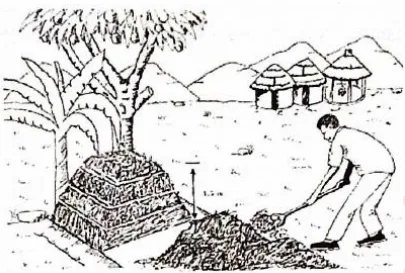
(a)(i) Compost manure (a compost heap).
(a)(ii) To mix and aerate the heap so that it decomposes faster and evenly.
(b) The decomposed remains of plants and animals (compost, kraal manure) added to the soil to supply nutrients and improve soil structure.
(c) Apply well-rotted manure into the planting stations or furrows (or broadcast it and plough it in), mix it with the soil, then plant the maize.
(d)(i) Nitrogen promotes vigorous leafy growth and dark green leaves, raising yield.
(d)(ii) It conserves soil moisture and fertility and reduces erosion, so yields improve.
Question 2
Figure 2 shows a gate for a cattle crush.
(a)(i) What material is part A made of? [1] (ii) State the purpose of the gate. [1]
(b) Describe the role of the cattle crush. [2]
(c)(i) Why do treated gum poles make good poles for the gate? [1] (ii) Give two reasons for building the crush correctly. [2]
(d) Explain the importance of spraying cattle. [1]
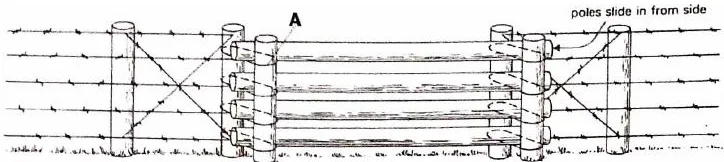
(a)(i) Wood (treated gum poles).
(a)(ii) To let cattle into or out of the crush and keep them confined inside.
(b) It holds (restrains) cattle firmly so that the farmer can safely dose, vaccinate, spray, dehorn, castrate, ear-tag and examine them without injury to the animals or the workers.
(c)(i) They are strong and straight, and resist termites and rotting, so they last a long time.
(c)(ii)
- So that it is strong and cattle cannot break it and escape.
- To prevent injury to the animals and the workers.
(d) It kills ticks and other external parasites that spread diseases such as East Coast Fever.
Question 3
Figure 3 shows a breed of cow.
(a) Identify the breed. [1] (b) Describe its conformation. [2]
(c) Outline the importance of water in the body of the cow. [2]
(d) Explain in-breeding in cattle. [2] (e) Explain the importance of the pressing technique during milking. [1]
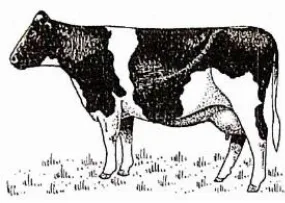
(a) Friesian (Holstein-Friesian).
(b) A dairy type: wedge-shaped body, large well-attached udder with prominent milk veins, thin neck, little flesh, and a large black-and-white body.
(c) Water regulates body temperature, helps digestion and the transport of nutrients, removes wastes in urine, and makes up most of the milk.
(d) In-breeding is the mating of closely related animals, for example a bull with its daughter. It fixes good traits, but it can bring out harmful recessive traits, reducing vigour and fertility.
(e) It removes milk quickly and completely without injuring the teats.
Question 4
(a) What is the art and science of organising and operating a farm business called? [1]
(b) Describe farm valuation. [2]
(c) How does a farmer use a cash-flow budget? [2]
(d) Outline two benefits of belonging to a cooperative. [2]
(e) What happens to machinery and buildings after several years of use? [1]
(a) Farm management.
(b) Estimating the worth of the farm’s assets (land, buildings, machinery, livestock and crops) at a given time, usually at the start and end of the year, to measure progress.
(c) It shows the money expected to come in and go out each month, so the farmer can plan spending, avoid running short of cash, and plan loans and repayments.
(d)
- Members buy inputs in bulk at lower prices.
- Members get better markets and prices, loans and training.
(e) They depreciate: they lose value through wear and tear and age.
Question 5
Figure 4 shows a farm structure for livestock.
(a)(i) Name the livestock kept in it. [1] (ii) Identify the main local materials used. [1] (iii) How does raising the structure improve the animals’ health? [3]
(b) Give two reasons why livestock structures are important. [2]
(c) Explain the importance of using pulleys on farms. [1]
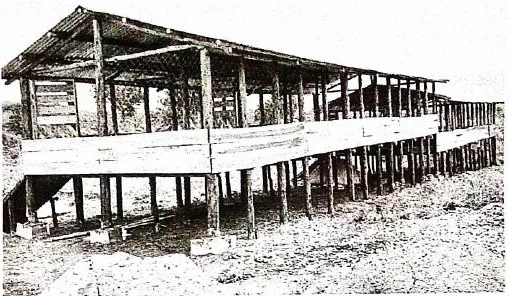
(a)(i) Goats (a raised goat house).
(a)(ii) Wooden (gum) poles and timber planks.
(a)(iii) The slatted floor lets droppings and urine fall through, keeping the floor dry and clean. This reduces worms, foot rot and pneumonia, and the raised floor improves ventilation.
(b)
- They protect animals from bad weather and predators.
- They make feeding, handling and disease control easier.
(c) Pulleys make lifting heavy loads (water, bags, hay) easier by reducing the effort needed.
SECTION B [60 MARKS]
Answer any three questions from this section.
Question 1
(a) State five uses of wood. [5]
(b) Describe five advantages of agro-forestry. [5]
(c)(i) How does increasing soil organic matter affect crop production? [5] (ii) Explain the physical effects of manure in the soil. [3]
(d)(i) How does crop rotation help to control pests and diseases? [1] (ii) Why should recommended amounts of manure be used? [1]
(a)
- Building: poles, timber and roof trusses for houses and farm structures.
- Fuel: firewood and charcoal for cooking and curing tobacco.
- Furniture: tables, chairs and beds.
- Fencing: posts and poles for kraals and crushes.
- Tool handles, carvings and pulp for paper.
(b)
- Leguminous trees fix nitrogen and leaf litter adds organic matter, improving soil fertility.
- Tree roots bind the soil and canopies break the force of rain, controlling erosion.
- Trees act as windbreaks and give shade to crops and livestock.
- Trees provide firewood, poles, timber and fodder.
- Fruit trees provide food and extra income, diversifying the farmer’s income.
(c)(i)
- Improves soil structure (crumb structure) and aeration, so roots grow well.
- Increases the water-holding capacity, so crops resist drought.
- Releases nutrients (N, P, S) slowly as it decomposes.
- Holds nutrients against leaching and buffers soil pH.
- Encourages earthworms and useful micro-organisms. The result is higher yields.
(c)(ii)
- Binds loose sandy soil and loosens heavy clay, improving soil structure.
- Increases water retention while improving drainage and aeration.
- Darkens the soil so it warms up faster, and reduces erosion.
(d)(i) Growing a different crop that is not a host breaks the life cycle of pests and disease organisms, so they starve and die out.
(d)(ii) Too much manure wastes money and can scorch crops or cause excessive leafy growth; too little gives poor yields.
Question 2
(a) Identify (i) four factors that make agriculture important in Zambia, [4] (ii) three contributions of a farmer to a country. [3]
(b) How are the results of farmers’ experiments disseminated? [5]
(c) Explain the effects of excessive application of ammonium nitrate. [2]
(d) Explain the effects of communal land tenure on agriculture. [2]
(e)(i) Explain the division of arable land. [3] (ii) How would you use hilly or mountainous land? [1]
(a)(i)
- Provides food for the nation (food security).
- Employs most of the population.
- Supplies raw materials to industries (cotton, sugarcane, tobacco).
- Earns foreign exchange from exports.
(a)(ii)
- Produces food.
- Pays taxes and levies.
- Creates employment.
(b)
- Field days and agricultural shows.
- Demonstration plots.
- Radio and television programmes.
- Leaflets, magazines and newspapers.
- Extension officers’ visits and farmer group meetings.
(c) It scorches crops, makes the soil acidic, causes excessive leafy growth and lodging, and leaches into water sources, polluting them.
(d) Farmers have no title deeds, so they cannot use land as security for loans. They do not invest in improving land they do not own, which leads to overgrazing and land degradation.
(e)(i) Arable land is divided into fields (plots) of about equal size, so that a different crop can be grown in each field and the crops rotated each year. This eases management, keeps the soil fertile and controls pests.
(e)(ii) Plant trees (forestry or orchards), grow crops on terraces, or keep it as pasture for grazing.
Question 3
(a) Name five parts of the digestive system of a hen. [5]
(b) Describe the economic importance of cattle. [4]
(c)(i) How is the Friesian suited to dairy farming? [5] (ii) Compare digestion in ruminants and non-ruminants. [5]
(d) Why is the doe always taken to the buck for mating? [1]
(a) Beak, oesophagus, crop, proventriculus, gizzard (also the small intestine, caeca, large intestine and cloaca).
(b)
- Milk and beef for food and sale.
- Draught power for ploughing and pulling carts.
- Hides for leather, and manure for crops.
- A form of savings, used for dowry (lobola), giving social status.
(c)(i)
- A very high milk yield (about 20 litres or more a day).
- A large, well-attached udder with well-placed teats.
- A large body and big appetite, converting much feed into milk.
- A long lactation period.
- Docile and easy to handle during milking.
(c)(ii)
| Ruminants (e.g. cattle) | Non-ruminants (e.g. pigs) |
|---|---|
| Four-chambered stomach: rumen, reticulum, omasum, abomasum | One simple stomach |
| Chew the cud (regurgitate and re-chew food) | Do not chew the cud |
| Microbes in the rumen digest cellulose | Digest mainly with enzymes; cannot use much fibre |
| Can live on roughage (grass, hay) | Need concentrates |
| Rumen microbes make B vitamins and protein | Must get these in their feed |
(d) The doe is territorial: if the buck is put into her hutch she may fight and injure him, while in the buck’s hutch she accepts mating.
Question 4
(a) List (i) three functions of a farm manager, [3] (ii) two classes of farm costs. [2]
(b) Describe intercropping. [4]
(c)(i) Calculate the profit on Mubita’s cabbage enterprise: 1 kg seed at K1 500.00; Solubor K500.00; 16 × 50 kg bags of D-Compound at K500.00 each; 6 × 50 kg bags of ammonium nitrate at K500.00 each; 8 bottles of pesticide at K15.00 each. 20 tonnes of cabbage were sold at K10.00 per kg. [6] (ii) What causes high profit in an enterprise? [2]
(d) What does the demand for an agricultural product depend on? [3]
(a)(i)
- Planning farm activities and budgets.
- Organising and directing labour and resources.
- Controlling (supervising) work and keeping records.
(a)(ii)
- Fixed costs, which do not change with output (rent, depreciation).
- Variable costs, which change with output (seed, fertiliser).
(b) Intercropping is growing two or more crops on the same land at the same time, for example maize and beans, in alternate rows or mixed. It makes better use of land, legumes add nitrogen, it reduces pests and the risk of total crop failure, and it covers the soil against erosion.
(c)(i) Set the costs out in a table:
| Item | Working | Cost (K) |
|---|---|---|
| Seed | 1 500 | |
| Solubor | 500 | |
| D-Compound | 16 × 500 | 8 000 |
| Ammonium nitrate | 6 × 500 | 3 000 |
| Pesticide | 8 × 15 | 120 |
| Total costs | 13 120 |
Income: 20 tonnes = 20 000 kg, and .
(c)(ii)
- High yields from good management and inputs.
- Good market prices with low production costs.
(d)
- The price of the product.
- Consumers’ income.
- Tastes and preferences (also the prices of substitutes and the size of the population).
Where marks are lost: forgetting to convert tonnes to kilograms. The price is per kilogram, so 20 tonnes must become 20 000 kg before you multiply.
Question 5
(a)(i) Mention five factors to consider when choosing a site for farm buildings. [5] (ii) State three advantages of mechanising agriculture. [3]
(b) How would a farmer maintain implements after the farming season? [5]
(c)(i) Outline how water for farming is obtained. [2] (ii) Explain the treatment of water for livestock. [2]
(d) Which conditions encourage rusting of iron implements? [3]
(a)(i)
- Well-drained, slightly raised ground that does not flood.
- Easy access to roads.
- Near a reliable water supply and electricity.
- Security against thieves and predators.
- Downwind of the homestead (because of smells), with room for future expansion.
(a)(ii)
- Work is done faster and on time.
- Larger areas can be cultivated.
- Less drudgery and lower labour costs.
(b)
- Clean off soil and plant remains.
- Repair or replace broken and worn-out parts.
- Sharpen cutting edges and tighten loose nuts and bolts.
- Oil or grease metal and moving parts, and paint where needed.
- Store them in a dry, roofed shed.
(c)(i) From rivers and streams, wells and boreholes, dams, and by harvesting rainwater from roofs.
(c)(ii) Let dirt settle (sedimentation), filter the water, then add chlorine (or boil small amounts) to kill germs.
(d)
- Water (moisture).
- Oxygen (air).
- Salts, fertiliser and acids left on the metal, which speed up rusting.
Keep practising
Try another paper under timed conditions, then check your work against the solutions.