SECTION A: SHORT ANSWER QUESTIONS [44 MARKS]
Answer all the questions in the spaces provided.
Question 1
Figure 1 shows two generalised cells from two different organisms.
(a)(i) Identify the parts labelled C, D and E. [3]
(a)(ii) State two ways in which cell G differs from cell H. [2]
(b) Explain the functions of (i) Golgi bodies, (ii) endoplasmic reticulum, (iii) mitochondria. [3]
(c) Identify the two labelled parts, one from each cell, which perform the same function. [1]
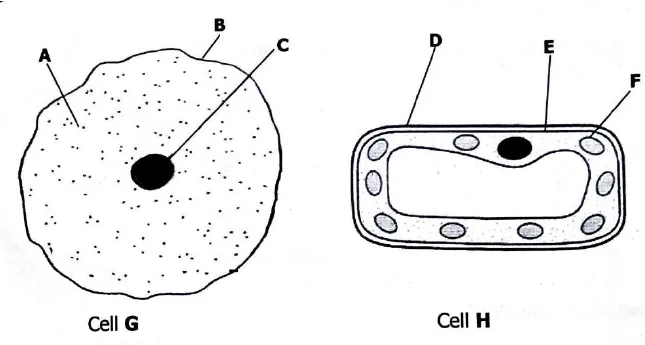
(a)(i) C: nucleus. D: cell wall. E: cell membrane (plasma membrane).
(a)(ii)
- Cell G has no cell wall, while cell H has a cell wall.
- Cell G has no chloroplasts and no large permanent vacuole, while cell H has chloroplasts and a large vacuole.
(b)
- Golgi bodies modify and package proteins such as enzymes, and carry them to where they are needed.
- Endoplasmic reticulum transports substances within the cytoplasm; rough ER carries proteins made on its ribosomes.
- Mitochondria are the site of aerobic respiration, releasing energy.
(c) B and E: both are cell membranes, which control what enters and leaves the cell.
Question 2
The dental formulae of animals P and Q are:
(a) Identify animals P and Q. [2]
(b) State the name given to animals with dental formulae P and Q. [2]
(c) Complete the table of types of teeth, their adaptations and functions. [5]
(a) P: dog. Q: human.
(b) P: carnivore (meat-eater, large canines and carnassial teeth). Q: omnivore (eats plants and animals).
(c)
| Type of teeth | Adaptation | Function |
|---|---|---|
| Incisors | Chisel-shaped | Cutting |
| Canines | Pointed | Gripping and tearing |
| Premolars | Broad with ridges (cusps) | Grinding |
| Molars | Broad with ridges (cusps) | Crushing and grinding |
A quick check: the human formula gives teeth. The dog has upper and lower teeth, 42 in total.
Question 3
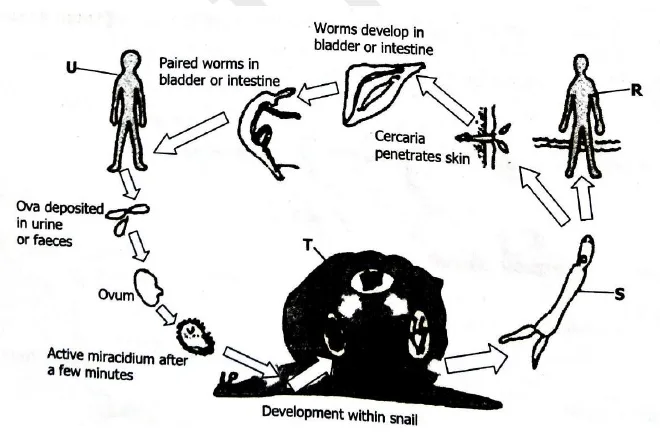
Figure 3 shows the transmission cycle of schistosomiasis.
(a)(i) What is the common name for schistosomiasis? [1] (ii) To which type of diseases does it belong? [1]
(b) From Figure 3, identify (i) the causative agent, (ii) the primary host, (iii) the secondary host. [3]
(c) State one sign and one symptom of schistosomiasis. [2]
(d) State two ways of preventing its transmission. [2]
(a)(i) Bilharzia.
(a)(ii) An infectious, parasitic disease, spread through contaminated fresh water (water-borne).
(b)(i) Causative agent: S, the larva (cercaria) of the blood fluke Schistosoma.
(b)(ii) Primary host: R / U, the human. The adult worms live, mate and lay eggs inside the human.
(b)(iii) Secondary (intermediate) host: T, the freshwater snail, where the larvae develop and multiply.
(c) Sign: blood in the urine or faeces (or anaemia). Symptom: tiredness, fever or abdominal pain.
(d)
- Boil or treat water before use, and avoid swimming or washing in snail-infested water.
- Use toilets so that urine and faeces do not reach rivers and dams.
Where marks are lost: swapping the hosts. The primary (definitive) host is where the parasite reproduces sexually: the human. The snail is the secondary (intermediate) host.
Question 4
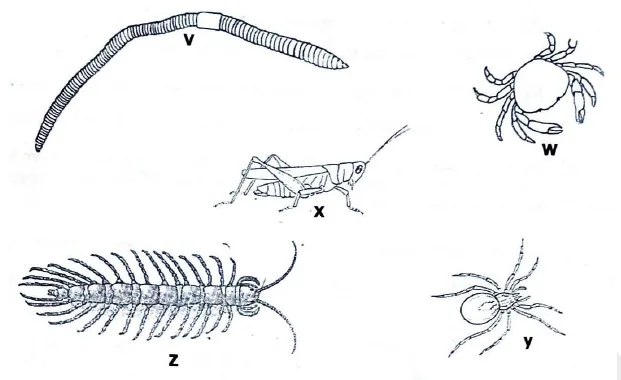
Figure 4 shows different organisms.
(a) Complete the dichotomous key, filling in blanks (i) to (iv) with the letters of the organisms. [4]
(b) Name the phylum to which the organisms with jointed limbs belong. [1]
(c) Organism X belongs to the class Insecta. State three characteristic features of insects. [3]
(a)
| Step | Description | Result |
|---|---|---|
| 1 | Jointed limbs | go to 2 |
| No jointed limbs | V | |
| 2 | More than 5 pairs of jointed limbs | (i) Z |
| 5 or fewer pairs of jointed limbs | go to 3 | |
| 3 | First pair of limbs form large claws | (ii) W |
| No large claws | go to 4 | |
| 4 | 3 pairs of limbs | (iii) X |
| 4 pairs of limbs | (iv) Y |
(b) Arthropoda.
(c)
- Three body parts: head, thorax and abdomen.
- Three pairs of jointed legs.
- One pair of antennae (and usually two pairs of wings).
Question 5
Haemophilia is a sex-linked characteristic.
(a)(i) Define the term sex-linked characteristic. [2] (ii) Name one other sex-linked characteristic. [1]
(b) Using a genetic diagram, explain how a haemophilic son can be born to a non-haemophilic mother and father. Use for non-haemophilic and for haemophilic. [6]
(a)(i) A characteristic controlled by a gene carried on a sex chromosome, usually the X chromosome.
(a)(ii) Red–green colour blindness.
(b)
| Mother | Father | |
|---|---|---|
| Parental phenotype | Normal (carrier) | Normal |
| Parental genotype | ||
| Gametes | and | and |
| Gametes | (father) | (father) |
|---|---|---|
| (mother) | normal female | normal male |
| (mother) | normal (carrier) female | haemophilic male |
Offspring: normal female, normal male, carrier female and haemophilic male (1 : 1 : 1 : 1).
The son is haemophilic because his mother is a carrier: she passed him the recessive allele . A boy’s only X chromosome comes from his mother, and the Y chromosome from his father carries no allele to mask it.
SECTION B: ESSAY QUESTIONS [36 MARKS]
Answer any three questions from this section. All answers must be in complete sentences and in paragraphs.
Question 1
(a) Describe the movement of water from the soil to the leaves in a plant. [9]
(b) Explain the process of transpiration. [3]
(a) Water in the soil exists as a thin film around the soil particles. The cell sap of the root hair cell is more concentrated than the soil solution, so water moves across the cell wall and cell membrane into the root hair by osmosis.
From the root hair, water moves into the cortex, passing from cell to cell by osmosis because each cell further in has a slightly more concentrated cell sap. Some water also moves along the cell walls. The water then enters the xylem vessels of the root.
It moves up the xylem of the root, through the stem and into the leaves as a continuous column (mass flow). The main force pulling the water upwards is the transpiration pull, created as water evaporates from the leaves. Root pressure and capillarity in the narrow xylem vessels also help.
(b) Transpiration is the loss of water as water vapour from the leaves of a plant. Water evaporates from the surfaces of the mesophyll cells into the air spaces, and the water vapour then diffuses out through the stomata into the atmosphere.
Question 2
(a) Describe the digestion of proteins in the alimentary canal of human beings. [8]
(b) Explain (i) absorption and (ii) assimilation. [4]
(a) In the mouth, food containing protein is broken into smaller pieces by chewing (mastication). This physical digestion increases the surface area for enzymes to act on. No protein-digesting enzyme is produced in the mouth.
In the stomach, chemical digestion of protein begins. The enzyme pepsin breaks proteins down into peptides (peptones). Hydrochloric acid provides the acidic pH that pepsin needs, and also kills bacteria.
In the duodenum, the enzyme trypsin in pancreatic juice breaks the remaining proteins into peptides. In the ileum, peptidase enzymes break the peptides into amino acids, the end products of protein digestion.
(b)(i) Absorption is the taking up of the end products of digestion into the blood. Glucose, amino acids and mineral salts pass through the walls of the villi into the blood capillaries, while fatty acids and glycerol pass into the lacteals (lymph).
(b)(ii) Assimilation is the use of absorbed nutrients by body cells. For example, glucose is used in respiration to release energy, amino acids are used to build new proteins for growth and repair, and excess glucose is stored as glycogen in the liver.
Question 3
(a) Identify the bones of named types of mammalian skeletons. [6]
(b) Describe the functions of the skeleton. [6]
(a) The mammalian skeleton has two parts.
The axial skeleton forms the main axis of the body. It is made up of the skull, the vertebral column (cervical, thoracic, lumbar, sacral and caudal vertebrae), the ribs and the sternum.
The appendicular skeleton is made up of the girdles and the limbs. The pectoral girdle consists of the scapula and clavicle, and the pelvic girdle of the ilium, ischium and pubis. The fore limb has the humerus, radius, ulna, carpals, metacarpals and phalanges; the hind limb has the femur, patella, tibia, fibula, tarsals, metatarsals and phalanges.
(b) The skeleton:
- supports the body and gives it its shape;
- protects delicate organs: the skull protects the brain, and the ribcage protects the heart and lungs;
- allows movement, because muscles are attached to bones and pull on them at joints;
- produces blood cells in the red bone marrow;
- stores minerals such as calcium and phosphorus;
- helps in breathing (the ribcage) and in hearing (the small bones of the middle ear transmit sound).
Question 4
(a) Explain the differentiation of primary and secondary tissues in plants. [6]
(b) Compare and contrast hypogeal and epigeal germination of seeds. [6]
(a) Primary tissues are formed by primary growth at the apical meristems of the shoot and root tips. The new cells divide, elongate and form vacuoles, then differentiate (specialise) to perform different functions. Examples are parenchyma, collenchyma, sclerenchyma, xylem and phloem. Primary growth makes the shoot grow upwards and the root grow downwards.
Secondary tissues are formed by secondary growth, which takes place in woody plants such as trees. The cambium divides, widening the stem or trunk. Extra xylem forms, which hardens into wood, and the outer tissues develop into bark.
(b) Similarity: both are ways in which a seed germinates into a seedling, and both need water, oxygen and a suitable temperature.
| Hypogeal germination | Epigeal germination |
|---|---|
| The epicotyl elongates | The hypocotyl elongates |
| Cotyledons stay below the soil | Cotyledons are carried above the soil |
| Example: maize (also pea) | Example: bean |
| Cotyledons or endosperm decay as food is used up | Cotyledons turn green and act as the first leaves |
| Plumule protected by the coleoptile (in maize) | Plumule protected between the cotyledons |
Question 5
(a) Describe the carbon cycle. [6]
(b) Explain the importance of conserving plant and animal species. [6]
(a) Carbon dioxide in the atmosphere is absorbed by green plants during photosynthesis and converted into organic compounds such as glucose. Plants release some carbon dioxide back into the atmosphere by respiration.
When animals eat plants, the carbon passes into the animals’ bodies (feeding). Animals also respire and release carbon dioxide.
When plants and animals die, decomposers such as bacteria and fungi break down their bodies and release carbon dioxide by respiration. Remains that do not decay may slowly form fossil fuels, and the combustion of fossil fuels returns carbon dioxide to the atmosphere.
(b) Conservation:
- prevents extinction, especially of endangered species such as the black rhino;
- protects habitats, which also keeps food chains and ecosystems balanced;
- keeps species for education and research;
- attracts tourists, bringing income and jobs to the country;
- protects plants that are sources of medicines and food;
- preserves the beauty (aesthetic value) of nature for future generations.
Keep practising
Try another paper under timed conditions, then check your work against the solutions.