GCE · Mathematics · 2026

GCE 2026 Mathematics Paper 2: Worked Solutions

Step-by-step worked solutions to every question in the 2026 GCE Mathematics Paper 2 (4024/2), with diagrams, graphs, final answers and tips on where marks are lost.

By MathGuide Updated 24 October 2026 Paper 4024/2 100 marks

SECTION A [52 MARKS]

Answer all questions in this section.

Question 1

1 (a) Express 7x−3−81−2x\dfrac{7}{x-3} - \dfrac{8}{1-2x} as a single fraction in its simplest form. [3]

Use the product of the two denominators as the common denominator:

7x−3−81−2x=7(1−2x)−8(x−3)(x−3)(1−2x)\begin{aligned} &\frac{7}{x-3} - \frac{8}{1-2x} \\ &= \frac{7(1-2x) - 8(x-3)}{(x-3)(1-2x)} \end{aligned}

Expand the numerator carefully. The minus sign multiplies both terms of 8(x−3)8(x-3):

=7−14x−8x+24(x−3)(1−2x)=31−22x(x−3)(1−2x)= \frac{7 - 14x - 8x + 24}{(x-3)(1-2x)} = \frac{31 - 22x}{(x-3)(1-2x)}

Answer: 31−22x(x−3)(1−2x)\dfrac{31 - 22x}{(x-3)(1-2x)}

1 (b) A box contains 2 green balls and 3 blue balls. A ball is selected at random and not replaced. A second ball is then selected.
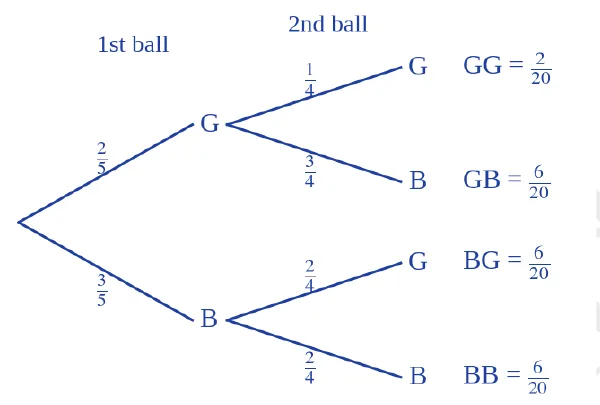
(i) Draw a tree diagram to illustrate the outcomes. [2]
(ii) What is the probability of selecting two balls of different colours? [3]

(i) After the first ball is taken, only 4 balls remain, so every second-ball probability has denominator 4.

Tree diagram: first ball green 2/5 or blue 3/5; second ball probabilities out of 4; GG = 2/20, GB = 6/20, BG = 6/20, BB = 6/20

(ii) “Different colours” means green then blue or blue then green:

P(different)=P(GB)+P(BG)=25×34+35×24=620+620=1220\begin{aligned} P(\text{different}) &= P(GB) + P(BG) \\ &= \frac{2}{5}\times\frac{3}{4} + \frac{3}{5}\times\frac{2}{4} \\ &= \frac{6}{20} + \frac{6}{20} = \frac{12}{20} \end{aligned}

Answer: 35\dfrac{3}{5}

Where marks are lost: using 35\frac{3}{5} again for the second ball. “Not replaced” always changes the second set of probabilities. Check that the four end results add up to 1: 2+6+6+620=1\frac{2+6+6+6}{20} = 1.

Question 2

2 (a) In a group of 40 girls, 25 like mangoes, 20 like bananas, 15 like guavas, 9 like mangoes and bananas, 10 like mangoes and guavas, 7 like bananas and guavas, and 4 like all three.
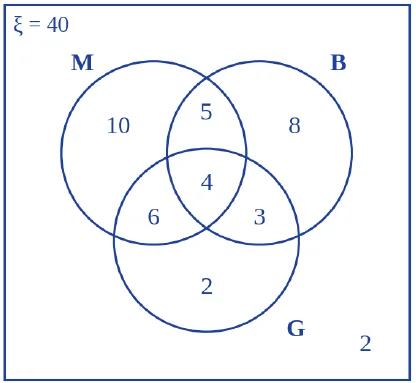
(i) Illustrate this in a Venn diagram. [2]
(ii) How many girls (a) like guavas only, (b) like two types of fruit, (c) do not like bananas? [3]

Always fill a three-set Venn diagram from the centre outwards.

  • All three: 44
  • Mangoes and bananas only: 9−4=59 - 4 = 5; mangoes and guavas only: 10−4=610 - 4 = 6; bananas and guavas only: 7−4=37 - 4 = 3
  • Mangoes only: 25−(5+4+6)=1025 - (5 + 4 + 6) = 10; bananas only: 20−(5+4+3)=820 - (5 + 4 + 3) = 8; guavas only: 15−(6+4+3)=215 - (6 + 4 + 3) = 2
  • None: 40−(10+8+2+5+6+3+4)=40−38=240 - (10 + 8 + 2 + 5 + 6 + 3 + 4) = 40 - 38 = 2
Venn diagram with universal set 40: mangoes only 10, bananas only 8, guavas only 2, M and B only 5, M and G only 6, B and G only 3, all three 4, none 2

(ii) (a) Guavas only: 2
(b) Exactly two types: 5+6+3=5 + 6 + 3 = 14
(c) Do not like bananas: 40−20=40 - 20 = 20

2 (b) The determinant of M=(x−3−1x+23)\mathbf{M} = \begin{pmatrix} x-3 & -1 \\ x+2 & 3 \end{pmatrix} is 5. Find (i) the value of xx, [2] (ii) the inverse of M\mathbf{M}. [2]

(i) For (abcd)\begin{pmatrix} a & b \\ c & d \end{pmatrix} the determinant is ad−bcad - bc:

3(x−3)−(−1)(x+2)=53x−9+x+2=54x=12\begin{aligned} 3(x-3) - (-1)(x+2) &= 5 \\ 3x - 9 + x + 2 &= 5 \\ 4x &= 12 \end{aligned}

Answer: x=3x = 3

(ii) When x=3x = 3, M=(0−153)\mathbf{M} = \begin{pmatrix} 0 & -1 \\ 5 & 3 \end{pmatrix}. Swap the leading diagonal, change the signs of the other two entries and divide by the determinant:

M−1=15(31−50)=(3515−10)\mathbf{M}^{-1} = \frac{1}{5}\begin{pmatrix} 3 & 1 \\ -5 & 0 \end{pmatrix} = \begin{pmatrix} \tfrac{3}{5} & \tfrac{1}{5} \\ -1 & 0 \end{pmatrix}

Question 3

3 (a) The second and fourth terms of a geometric progression are 6 and 1.5. Find (i) the common ratio and the first term, [3] (ii) the 8th term, [2] (iii) the sum to infinity. [2]

(i) Using Tn=arn−1T_n = ar^{n-1}:   ar=6  …(1)  \;ar = 6 \;\ldots(1)\; and   ar3=1.5  …(2)\;ar^3 = 1.5 \;\ldots(2)

Divide (2) by (1) to remove aa:

ar3ar=1.56  ⇒  r2=14  ⇒  r=±12\frac{ar^3}{ar} = \frac{1.5}{6} \;\Rightarrow\; r^2 = \frac{1}{4} \;\Rightarrow\; r = \pm\frac{1}{2}

With r=0.5r = 0.5: a=60.5=12a = \dfrac{6}{0.5} = 12.

Answer: r=0.5r = 0.5 and a=12a = 12 (or r=−0.5r = -0.5 and a=−12a = -12)

(ii) T8=ar7=12×(0.5)7=0.09375T_8 = ar^7 = 12 \times (0.5)^7 = 0.09375. Answer: 0.09380.0938 (3 s.f.)

(iii) S∞=a1−r=121−0.5=24S_\infty = \dfrac{a}{1-r} = \dfrac{12}{1-0.5} = 24. Answer: 2424 (with r=−0.5r = -0.5, a=−12a = -12: S∞=−8S_\infty = -8)

3 (b) Evaluate ∫−11(3−4x+9x2−4x3) dx\displaystyle\int_{-1}^{1} (3 - 4x + 9x^2 - 4x^3)\,dx. [3]

Increase each power by 1 and divide by the new power:

∫−11(3−4x+9x2−4x3) dx=[ 3x−2x2+3x3−x4 ]−11\begin{aligned} &\int_{-1}^{1} (3 - 4x + 9x^2 - 4x^3)\,dx \\ &= \Big[\,3x - 2x^2 + 3x^3 - x^4\,\Big]_{-1}^{1} \end{aligned} =(3−2+3−1)−(−3−2−3−1)=3−(−9)=12\begin{aligned} &= (3 - 2 + 3 - 1) - (-3 - 2 - 3 - 1) \\ &= 3 - (-9) = 12 \end{aligned}

Answer: 1212

Where marks are lost: substituting x=−1x = -1 carelessly. (−1)2=1(-1)^2 = 1 and (−1)4=1(-1)^4 = 1, but (−1)3=−1(-1)^3 = -1. Put every negative value in brackets before squaring or cubing.

Question 4

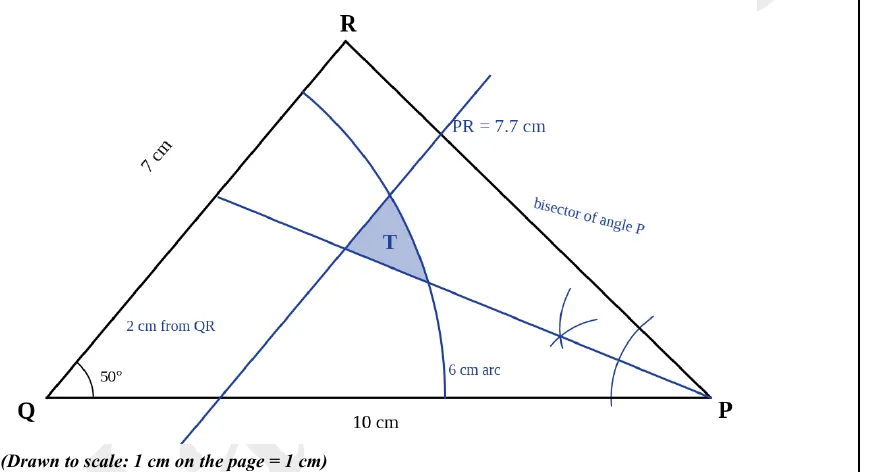
4 (a) (i) Construct triangle PQR with PQ = 10 cm, QR = 7 cm and angle PQR = 50°. [1] (ii) Measure PR. [1]
(b) Within the triangle, construct the locus of points (i) 6 cm from Q, [1] (ii) 2 cm from QR, [1] (iii) equidistant from PR and PQ. [2]
(c) Point T is at most 6 cm from Q, more than 2 cm from QR and nearer to PR than to PQ. Shade the region where T lies. [2]

Triangle PQR with PQ 10 cm, QR 7 cm, angle Q 50 degrees; arc of radius 6 cm centred at Q, line parallel to QR 2 cm away, bisector of angle P, and shaded region T
  • (a)(ii) PR = 7.7 cm. You can check this with the cosine rule: PR2=102+72−2(10)(7)cos⁡50∘=59.0PR^2 = 10^2 + 7^2 - 2(10)(7)\cos 50^\circ = 59.0, so PR≈7.68PR \approx 7.68 cm.
  • (b)(i) An arc of radius 6 cm with centre Q.
  • (b)(ii) A line parallel to QR, 2 cm from it, inside the triangle.
  • (b)(iii) Points equidistant from two lines lie on the bisector of the angle between them, here the bisector of angle QPR.
  • (c) T lies inside the arc, on the far side of the parallel line from QR, and on the PR side of the angle bisector: the shaded region.

Where marks are lost: rubbing out construction arcs. Examiners award marks for visible arcs, so leave them on your diagram.

Question 5

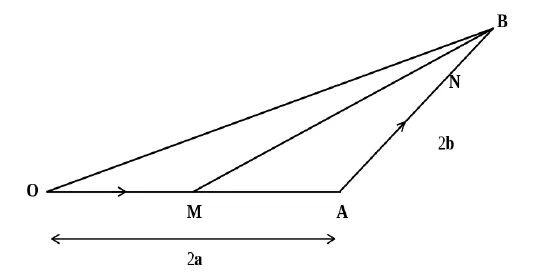
5 (a) In the diagram, OA→=2a\overrightarrow{OA} = 2\mathbf{a}, AB→=2b\overrightarrow{AB} = 2\mathbf{b}, M is the midpoint of OA and AN = 2NB. Express in terms of a\mathbf{a} and/or b\mathbf{b}: (i) OB→\overrightarrow{OB}, [1] (ii) MB→\overrightarrow{MB}, [1] (iii) ON→\overrightarrow{ON}, [1] (iv) MN→\overrightarrow{MN}. [2]

Diagram of triangle OAB with M the midpoint of OA and N on AB

Find a route along known vectors from the start point to the end point.

  • (i) OB→=OA→+AB→=2a+2b\overrightarrow{OB} = \overrightarrow{OA} + \overrightarrow{AB} = 2\mathbf{a} + 2\mathbf{b}
  • (ii) MA→=a\overrightarrow{MA} = \mathbf{a} (half of OA), so MB→=MA→+AB→=a+2b\overrightarrow{MB} = \overrightarrow{MA} + \overrightarrow{AB} = \mathbf{a} + 2\mathbf{b}
  • (iii) AN = 2NB means N is 23\frac{2}{3} of the way from A to B: AN→=23×2b=43b\overrightarrow{AN} = \frac{2}{3} \times 2\mathbf{b} = \frac{4}{3}\mathbf{b}, so ON→=2a+43b\overrightarrow{ON} = 2\mathbf{a} + \frac{4}{3}\mathbf{b}
  • (iv) MN→=MA→+AN→=a+43b\overrightarrow{MN} = \overrightarrow{MA} + \overrightarrow{AN} = \mathbf{a} + \frac{4}{3}\mathbf{b}

5 (b) Solve x2+6x+1=0x^2 + 6x + 1 = 0, giving your answers correct to 2 decimal places. [5]

“Correct to 2 decimal places” tells you the equation does not factorise, so use the formula with a=1a = 1, b=6b = 6, c=1c = 1:

x=−b±b2−4ac2a=−6±36−42=−6±322=−6±5.6572\begin{aligned} x &= \frac{-b \pm \sqrt{b^2 - 4ac}}{2a} = \frac{-6 \pm \sqrt{36 - 4}}{2} \\ &= \frac{-6 \pm \sqrt{32}}{2} = \frac{-6 \pm 5.657}{2} \end{aligned} x=−3+2.828orx=−3−2.828x = -3 + 2.828 \quad\text{or}\quad x = -3 - 2.828

Answer: x=−0.17x = -0.17 or x=−5.83x = -5.83

Question 6

6 (a) Simplify 2x2−50x+5\dfrac{2x^2 - 50}{x + 5}. [2]

Take out the common factor, then use the difference of two squares:

2x2−50x+5=2(x2−25)x+5=2(x+5)(x−5)x+5=2(x−5)\begin{aligned} \frac{2x^2 - 50}{x+5} &= \frac{2(x^2 - 25)}{x+5} \\ &= \frac{2(x+5)(x-5)}{x+5} = 2(x-5) \end{aligned}

Answer: 2(x−5)2(x - 5) or 2x−102x - 10

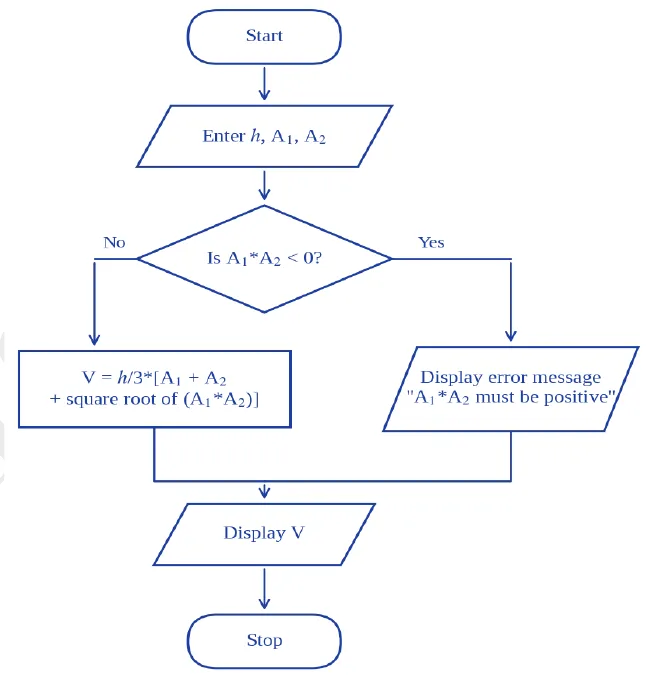
6 (b) Draw a flowchart for this pseudocode: Start → Enter hh, A₁, A₂ → IF A₁·A₂ < 0 THEN display “A₁·A₂ must be positive”, ELSE V=h3[A1+A2+A1A2]V = \frac{h}{3}\left[A_1 + A_2 + \sqrt{A_1 A_2}\right] → Display V → Stop. [5]

Use the correct symbols: rounded boxes for Start/Stop, parallelograms for input and output, a rectangle for a calculation and a diamond for the decision.

Flowchart: Start, input h A1 A2, decision is A1 times A2 less than 0, yes displays error message, no calculates V, then display V and stop

SECTION B [48 MARKS]

Answer any four questions in this section.

Question 7

7 (a) For y=x3−5x2−x+5y = x^3 - 5x^2 - x + 5:

xx−2−1012345.2
yy−21050−9−16qq5.2

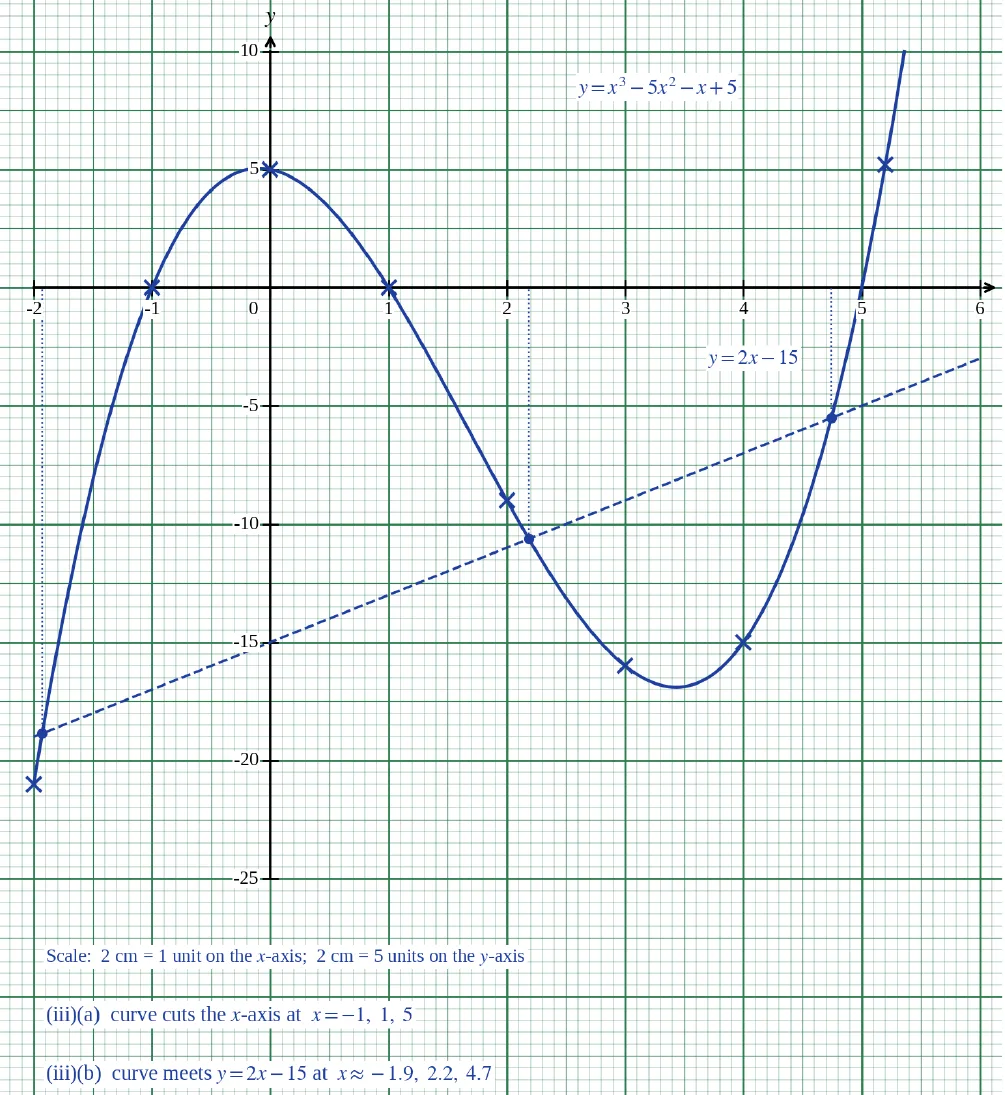
(i) Calculate qq. [1] (ii) Draw the graph for −2≤x≤6-2 \le x \le 6 (2 cm to 1 unit on xx, 2 cm to 5 units on yy). [3] (iii) Use your graph to solve (a) x3−5x2−x+5=0x^3 - 5x^2 - x + 5 = 0 [2] and (b) x3−5x2−x+5=2x−15x^3 - 5x^2 - x + 5 = 2x - 15. [3]

(i) q=43−5(4)2−4+5=64−80−4+5=−15q = 4^3 - 5(4)^2 - 4 + 5 = 64 - 80 - 4 + 5 = -15

Graph of y = x cubed minus 5 x squared minus x plus 5, with the line y = 2x minus 15 drawn dashed

(iii)(a) The solutions are where the curve cuts the xx-axis (y=0y = 0): x=−1x = -1, x=1x = 1, x=5x = 5.

(iii)(b) Draw the straight line y=2x−15y = 2x - 15 on the same axes and read the xx-values where it meets the curve: x≈−1.9x \approx -1.9, 2.22.2, 4.74.7.

7 (b) Find the equation of the tangent to y=x3−x2−15x+3y = x^3 - x^2 - 15x + 3 at the point (1,−12)(1, -12). [3]

dydx=3x2−2x−15At x=1:  m=3−2−15=−14\begin{aligned} \frac{dy}{dx} &= 3x^2 - 2x - 15 \\ \text{At } x = 1:\; m &= 3 - 2 - 15 = -14 \end{aligned} y−(−12)=−14(x−1)y+12=−14x+14\begin{aligned} y - (-12) &= -14(x - 1) \\ y + 12 &= -14x + 14 \end{aligned}

Answer: y=−14x+2y = -14x + 2

Question 8

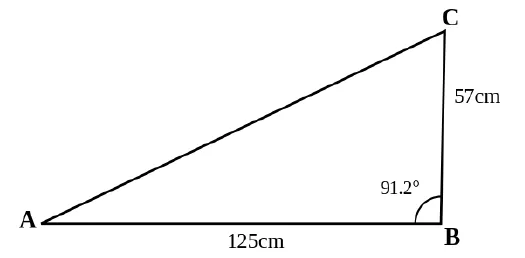
8 (a) In triangle ABC, AB = 125 cm, BC = 57 cm and angle ABC = 91.2°. Calculate (i) AC, [5] (ii) the area of triangle ABC, [2] (iii) the shortest distance from B to AC. [2]

Triangle ABC with AB 125 cm, BC 57 cm and angle B 91.2 degrees

(i) Two sides and the angle between them, so use the cosine rule. Note that cos⁡91.2∘\cos 91.2^\circ is negative:

AC2=1252+572−2(125)(57)cos⁡91.2∘=15 625+3 249−14 250(−0.020942)=19 172.4\begin{aligned} AC^2 &= 125^2 + 57^2 - 2(125)(57)\cos 91.2^\circ \\ &= 15\,625 + 3\,249 - 14\,250(-0.020942) \\ &= 19\,172.4 \end{aligned} AC=19 172.4=138.46AC = \sqrt{19\,172.4} = 138.46

Answer: AC=138AC = 138 cm (3 s.f.)

(ii)

Area=12×125×57×sin⁡91.2∘=3 561.7\text{Area} = \tfrac{1}{2} \times 125 \times 57 \times \sin 91.2^\circ = 3\,561.7

Answer: 3 560 cm23\,560\ \text{cm}^2 (3 s.f.)

(iii) The shortest distance from B to AC is the perpendicular height hh with AC as the base:

12×138.46×h=3 561.7h=2×3 561.7138.46=51.4\begin{aligned} \tfrac{1}{2} \times 138.46 \times h &= 3\,561.7 \\ h &= \frac{2 \times 3\,561.7}{138.46} = 51.4 \end{aligned}

Answer: 51.451.4 cm

Where marks are lost: rounding AC to 138 and then using 138 in part (iii). Keep the unrounded value (138.46) in later working and round only the final answer.

8 (b) Solve tan⁡θ=0.7\tan\theta = 0.7 for 180∘≤θ≤360∘180^\circ \le \theta \le 360^\circ. [1]
(c) Simplify 52x2y25a2b2÷13x2y310a3b2\dfrac{52x^2y^2}{5a^2b^2} \div \dfrac{13x^2y^3}{10a^3b^2}. [2]

(b) tan⁡−1(0.7)=35.0∘\tan^{-1}(0.7) = 35.0^\circ. Tan is positive in the first and third quadrants; in the given range we need the third: θ=180∘+35.0∘\theta = 180^\circ + 35.0^\circ.

Answer: θ=215.0∘\theta = 215.0^\circ

(c) Dividing by a fraction is multiplying by its reciprocal:

52x2y25a2b2×10a3b213x2y3=520 x2y2a3b265 a2b2x2y3=8ay\begin{aligned} &\frac{52x^2y^2}{5a^2b^2} \times \frac{10a^3b^2}{13x^2y^3} \\ &= \frac{520\,x^2y^2a^3b^2}{65\,a^2b^2x^2y^3} = \frac{8a}{y} \end{aligned}

Answer: 8ay\dfrac{8a}{y}

Question 9

9 The table shows the ages of 70 people in a town.

Age (years)0 < x ≤ 1010 < x ≤ 2020 < x ≤ 3030 < x ≤ 4040 < x ≤ 5050 < x ≤ 60
Frequency4161820102

(a) Calculate the standard deviation. [6]
(b) (i) Complete the relative cumulative frequency table. [1] (ii) Draw a smooth relative cumulative frequency curve. [3] (iii) Use your graph to estimate the interquartile range. [2]

(a) Use the mid-point of each class as xx:

Mid-point xx51525354555Total
ff416182010270
fxfx202404507004501101 970
fx2fx^21003 60011 25024 50020 2506 05065 750
xˉ=ΣfxΣf=197070=28.14\bar{x} = \frac{\Sigma fx}{\Sigma f} = \frac{1970}{70} = 28.14 SD=Σfx2Σf−xˉ2=65 75070−28.142=147.27=12.14\begin{aligned} \text{SD} &= \sqrt{\frac{\Sigma fx^2}{\Sigma f} - \bar{x}^2} = \sqrt{\frac{65\,750}{70} - 28.14^2} \\ &= \sqrt{147.27} = 12.14 \end{aligned}

Answer: SD ≈ 12.1 years

(b)(i) Divide each cumulative frequency by 70:

Age (years)≤ 0≤ 10≤ 20≤ 30≤ 40≤ 50≤ 60
Cumulative frequency042038586870
Relative cumulative frequency0.000.060.290.540.830.971.00

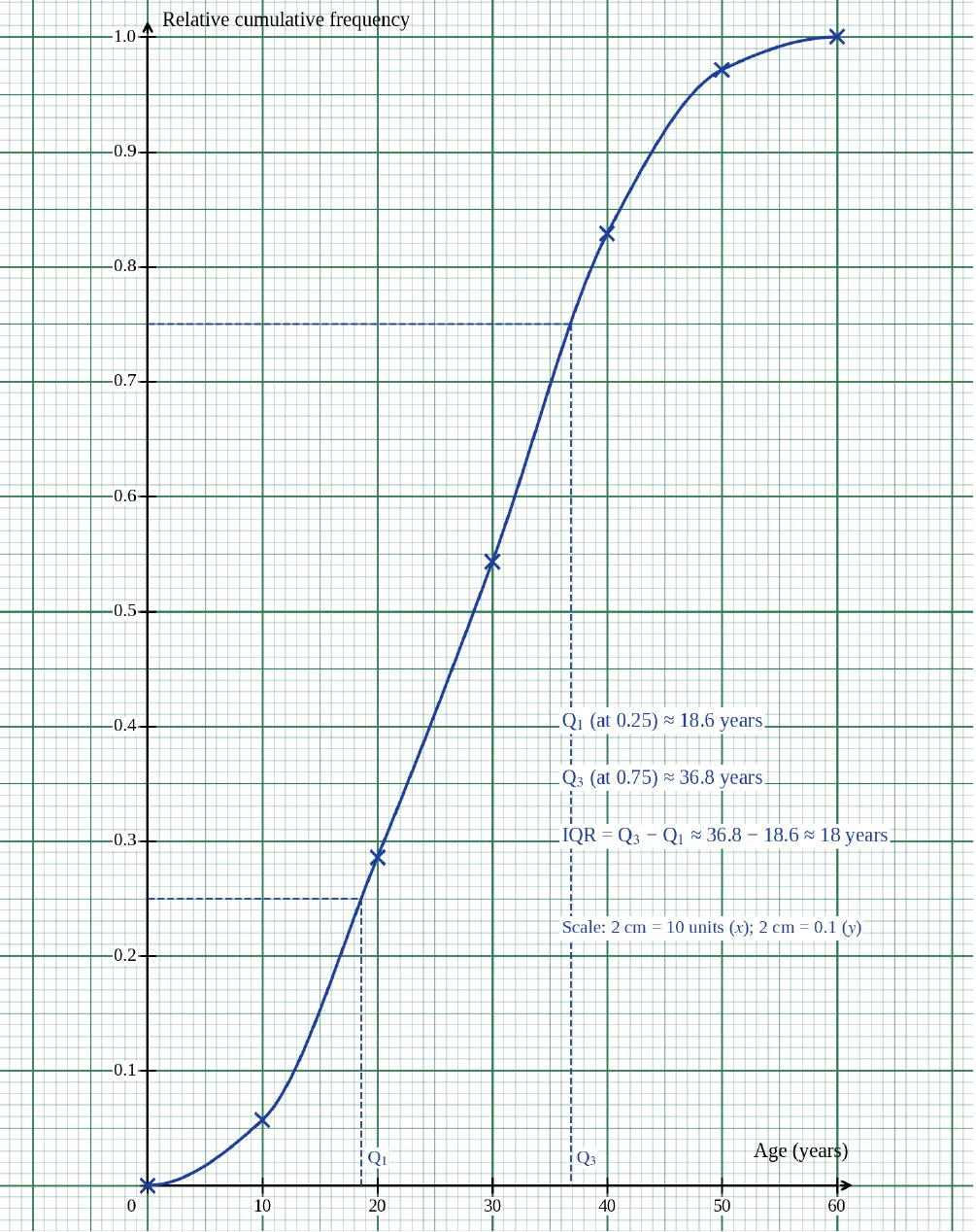
(ii) and (iii) Plot each value at the upper class boundary (10, 20, 30…), not at the mid-point.

Relative cumulative frequency curve of age, with lower quartile about 18.6 years and upper quartile about 36.8 years marked

Read across from 0.25 and 0.75: Q1≈18.6Q_1 \approx 18.6 years and Q3≈36.8Q_3 \approx 36.8 years.

Answer: IQR =Q3−Q1≈36.8−18.6≈18= Q_3 - Q_1 \approx 36.8 - 18.6 \approx 18 years

Question 10

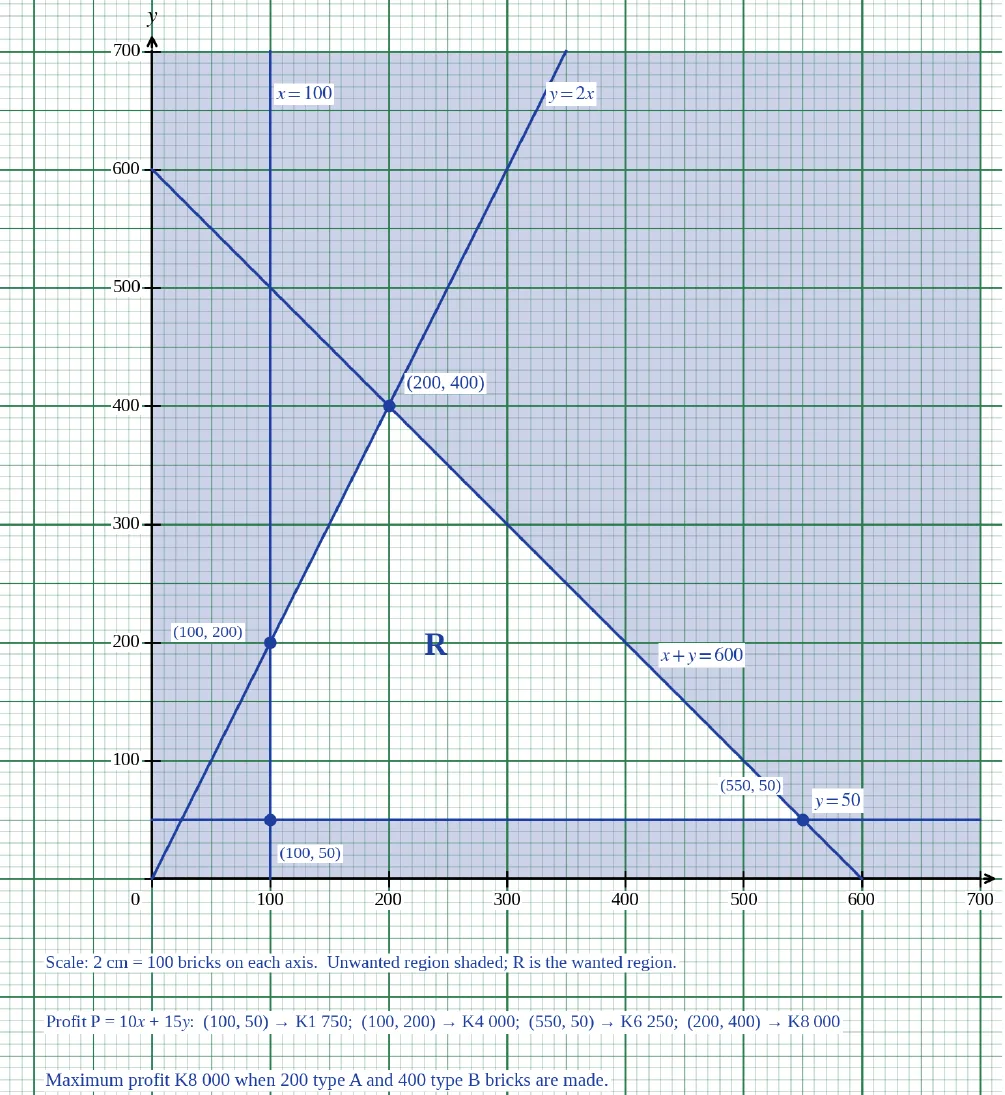
10 A man makes type A and type B bricks. He makes at least 100 type A and at least 50 type B, at most 600 bricks altogether, and the number of type B bricks must not be more than twice the number of type A.
(a) Write four inequalities, with xx type A and yy type B bricks. [4]
(b) Using 2 cm to 100 bricks on each axis, shade the unwanted region. [4]
(c) The profit is K10.00 on type A and K15.00 on type B. How many of each should he make to maximise profit? [2]
(d) Calculate the maximum profit. [2]

(a) x≥100,y≥50,x+y≤600,y≤2xx \ge 100,\quad y \ge 50,\quad x + y \le 600,\quad y \le 2x

(b)

Graph of the lines x = 100, y = 50, x + y = 600 and y = 2x with unwanted regions shaded; the wanted region R has vertices (100, 50), (100, 200), (200, 400) and (550, 50)

(c) Test the profit P=10x+15yP = 10x + 15y at each vertex of the wanted region:

Vertex(100, 50)(100, 200)(550, 50)(200, 400)
ProfitK1 750K4 000K6 250K8 000

Answer: 200 type A bricks and 400 type B bricks

(d) 10(200)+15(400)=2 000+6 00010(200) + 15(400) = 2\,000 + 6\,000. Answer: K8 000.00

Question 11

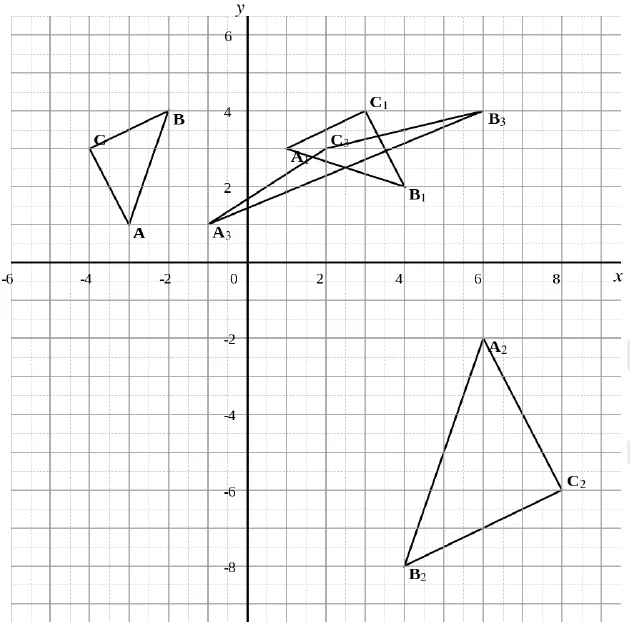
11 Study the diagram.
(a) Describe fully the single transformation mapping ABC onto A₁B₁C₁. [3]
(b) An enlargement maps ABC onto A₂B₂C₂. Find the centre and scale factor. [3]
(c) A shear maps ABC onto A₃B₃C₃. Find (i) its matrix, [2] (ii) the shear factor. [1]
(d) The matrix (3001)\begin{pmatrix} 3 & 0 \\ 0 & 1 \end{pmatrix} maps ABC onto A₄B₄C₄. Find A₄, B₄ and C₄. [3]

Coordinate grid showing triangle ABC and its images A1B1C1, A2B2C2 and A3B3C3

Read the coordinates first: A(−3, 1), B(−2, 4), C(−4, 3); A₁(1, 3), B₁(4, 2), C₁(3, 4).

(a) Each point follows (x,y)→(y,−x)(x, y) \to (y, -x), for example A(−3, 1) → (1, 3).
Answer: a rotation of 90° clockwise (−90°) about the origin (0, 0). A full description needs all three: rotation, angle with direction, and centre.

(b) A₂(6, −2) = −2 × A(−3, 1), B₂(4, −8) = −2 × B(−2, 4), C₂(8, −6) = −2 × C(−4, 3).
Answer: centre (0, 0), scale factor −2

(c)(i) A₃(−1, 1), B₃(6, 4), C₃(2, 3): the yy-coordinates are unchanged and x′=x+kyx' = x + ky. Using B: −2+4k=6-2 + 4k = 6, so k=2k = 2 (check with A: −3+2(1)=−1-3 + 2(1) = -1 ✓).

Answer: (1201)\begin{pmatrix} 1 & 2 \\ 0 & 1 \end{pmatrix}

(ii) Answer: shear factor =2= 2

(d)

(3001)(−3−2−4143)=(−9−6−12143)\begin{aligned} &\begin{pmatrix} 3 & 0 \\ 0 & 1 \end{pmatrix}\begin{pmatrix} -3 & -2 & -4 \\ 1 & 4 & 3 \end{pmatrix} \\ &= \begin{pmatrix} -9 & -6 & -12 \\ 1 & 4 & 3 \end{pmatrix} \end{aligned}

Answer: A₄(−9, 1), B₄(−6, 4), C₄(−12, 3)

Question 12

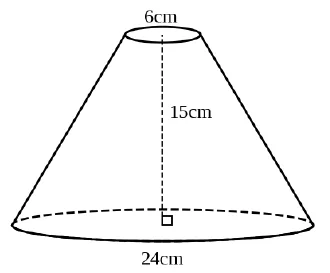
12 (a) A frustum of a cone has base diameter 24 cm, top diameter 6 cm and height 15 cm. Taking π=3.142\pi = 3.142, calculate (i) the height of the full cone, [2] (ii) the volume of the frustum. [4]

Frustum of a cone with top diameter 6 cm, base diameter 24 cm and height 15 cm

(i) Let the small cone that was removed have height hh. The small and full cones are similar, so heights are in the same ratio as radii (3 : 12):

hh+15=62424h=6h+9018h=90  ⇒  h=5\begin{aligned} \frac{h}{h + 15} &= \frac{6}{24} \\ 24h &= 6h + 90 \\ 18h &= 90 \;\Rightarrow\; h = 5 \end{aligned}

Answer: height of the full cone =5+15=20= 5 + 15 = 20 cm

(ii) Volume of frustum = volume of full cone − volume of small cone:

V=13πR2H−13πr2h=13×3.142×(122×20−32×5)\begin{aligned} V &= \tfrac{1}{3}\pi R^2 H - \tfrac{1}{3}\pi r^2 h \\ &= \tfrac{1}{3} \times 3.142 \times (12^2 \times 20 - 3^2 \times 5) \end{aligned} =13×3.142×(2880−45)=13×3.142×2835=2969.19\begin{aligned} &= \tfrac{1}{3} \times 3.142 \times (2880 - 45) \\ &= \tfrac{1}{3} \times 3.142 \times 2835 = 2969.19 \end{aligned}

Answer: 2 970 cm32\,970\ \text{cm}^3 (3 s.f.)

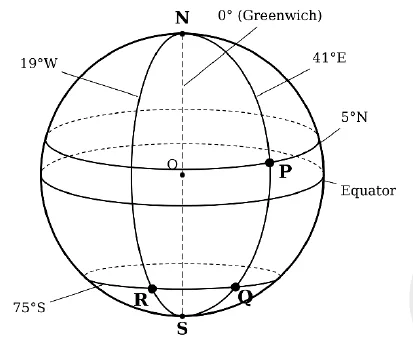
12 (b) P(5°N, 41°E), Q(75°S, 41°E) and R(75°S, 19°W) are on the earth’s surface. Take π=3.142\pi = 3.142 and R = 3 437 nm.
(i) Sketch the earth showing P, Q and R. [2]
(ii) Calculate, in nautical miles, (a) PQ, [2] (b) QR. [2]

(i)

Sketch of the earth showing the equator, the Greenwich meridian, meridians 41 degrees east and 19 degrees west, and points P, Q and R

(ii)(a) P and Q are on the same meridian (41°E), a great circle. One is north and one is south of the equator, so add the latitudes: θ=5∘+75∘=80∘\theta = 5^\circ + 75^\circ = 80^\circ.

PQ=80360×2×3.142×3437=4 799.6 nm\begin{aligned} PQ &= \frac{80}{360} \times 2 \times 3.142 \times 3437 \\ &= 4\,799.6 \text{ nm} \end{aligned}

Answer: PQ ≈ 4 800 nm. (Quick check: 1° along a great circle is 60 nm, and 80×60=4 80080 \times 60 = 4\,800.)

(ii)(b) Q and R are on the same parallel (75°S), a small circle of radius Rcos⁡75∘R\cos 75^\circ. One is east and one is west of Greenwich, so add the longitudes: θ=41∘+19∘=60∘\theta = 41^\circ + 19^\circ = 60^\circ.

QR=60360×2×3.142×3437×cos⁡75∘=3 599.7×0.2588=931.6 nm\begin{aligned} QR &= \frac{60}{360} \times 2 \times 3.142 \times 3437 \times \cos 75^\circ \\ &= 3\,599.7 \times 0.2588 = 931.6 \text{ nm} \end{aligned}

Answer: QR ≈ 932 nm

Where marks are lost: forgetting the cos⁡(latitude)\cos(\text{latitude}) factor for distances along a parallel. Only the equator and meridians are great circles.

Keep practising

Try another paper under timed conditions, then check your work against the solutions.