SECTION A [20 MARKS]
Answer all the questions in this section.
Question 1
1 The unwritten constitution is easily adaptable to the changing needs of society. This means it is …
A clear
B flexible
C stable
D unstable
Answer: B (flexible). “Easily adaptable” means it can be changed without a special procedure. A written constitution that is hard to amend is called rigid.
Question 2
2 Zambia uses a dual electoral system during general elections. This shows that Zambia …
A goes for elections twice
B has two types of elections
C uses a dual legal system
D uses two types of electoral systems
Answer: D. Zambia uses the 50% + 1 majority system for the president and first-past-the-post for members of parliament and councillors.
Question 3
3 Which aspect of citizenship acknowledges the value of self-discipline and self-control?
A legal aspects
B moral aspects
C principles
D rights
Answer: B (moral aspects). Self-discipline and self-control are personal values about right and wrong behaviour, not legal requirements.
Question 4
4 Which term describes an officer who is accountable for making sure that the rights of all people are respected, protected and fulfilled?
A duty bearer
B empowerment officer
C recognising officer
D rights holder
Answer: A (duty bearer). In the human-rights approach, citizens are rights holders and the state and its officers are duty bearers.
Question 5
5 Corruption where government workers fail to follow written procedures is called …
A laundering
B maladministration
C procedures
D red tape
Answer: B (maladministration). Red tape is the opposite problem: excessive rules and paperwork that delay services.
Question 6
6 What is the process of blending minority and majority groups through social bonding such as marriage?
A amalgamation
B assimilation
C interaction
D relativism
Answer: A (amalgamation). In amalgamation, groups blend through intermarriage to form a new mixed group. In assimilation, a minority gives up its culture and adopts the majority’s.
Question 7
7 A situation where some people are tempted to try out substances is referred to as …
A alienation
B changing structures
C curiosity
D peer pressure
Answer: C (curiosity). Wanting to find out what a substance feels like is curiosity. Peer pressure is when friends push you to try it.
Question 8
8 Which is not a reason for which the law permits a person to be required to perform forced labour?
A hard labour sentenced by a court
B failure to pay tax, rate or due
C hygiene while in detention
D security during a state of emergency
Answer: B. Zambia’s Bill of Rights allows labour ordered by a court, labour needed for hygiene in detention and labour required during an emergency. Failing to pay a tax is dealt with by fines or court action, not forced labour.
Question 9
9 Which of the following is a characteristic of press freedom?
A Government-owned television station gives air time to the opposition.
B Only journalists from the state-owned media organisation are allowed to cover the ruling party.
C Police beat up and arrest journalists for covering illegal demonstrations.
D The Minister of Home Affairs deports a foreign journalist for writing critical articles.
Answer: A (a government-owned television station gives air time to the opposition). Press freedom means all views can be reported. The other options describe restrictions on the press.
Question 10
10 The quality and effective utilisation of the working population can be related to …
A efficiency of labour
B labour force
C productive goods
D positive work culture
Answer: A (efficiency of labour). The labour force is simply the number of people able to work; efficiency describes how well they work.
Question 11
11 Bawesu appealed a divorce settlement to the Magistrate Court, which decided his case using the earlier case of Wabwino v Mubuto (2020). Which source of law was used?
A customary law
B common law
C law reports
D law of appeal
Answer: C (law reports). Earlier court decisions (judicial precedents) are recorded in law reports, which courts follow when deciding similar cases.
Question 12
12 A committee shared K50 000 among four cooperatives fairly according to their needs. Which principle did it use?
A equality
B equity
C gender
D stereotype
Answer: B (equity). Equality would give each the same amount (K12 500); equity gives according to need.
Question 13
13 Violence starts in our minds when we …
A hurt other people
B injure other people
C lose inner peace
D love inner violence
Answer: C (lose inner peace). Hurting and injuring people are the results of violence; it begins inside us when we lose inner peace.
Question 14
14 A man who impregnates a woman and refuses to support the child after birth is an example of child …
A abuse
B dumping
C neglect
D stigmatisation
Answer: C (neglect). Neglect is failing to provide a child’s basic needs such as food, shelter and care.
Question 15
15 The institutions and mechanisms that are used to promote and protect human rights are known as …
A International Covenant on Economic, Social and Cultural Rights.
B International Covenant on Civil and Political Rights.
C International Human Rights Instruments.
D Universal Declaration of Human Rights.
Answer: C (International Human Rights Instruments). Options A, B and D are each examples of such instruments.
Questions 16 and 17
Study the diagram and answer questions 16 and 17.
16 What do the variables in the diagram show?
A Basic human needs
B Economic resources
C Factors of capital accumulation
D Indicators of development
17 The variable marked Z on the diagram is known as Human Development …
A Identification.
B Index.
C Indicator.
D Information.
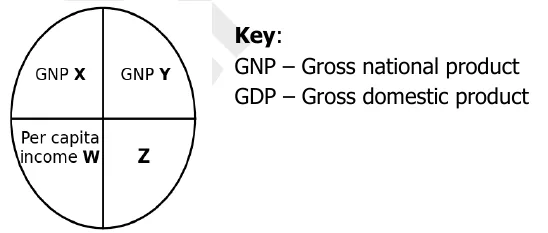
Answer 16: D (indicators of development). GNP, GDP and per capita income are all used to measure how developed a country is.
Answer 17: B (Index). The Human Development Index (HDI) combines life expectancy, education and income.
Question 18
18 Mr Zwabusu says: “Look at the house and count the number of holes. Look at the utensils I am using and the clothes I am wearing. What you see is poverty.” Which level of poverty is he describing?
A economic status
B personal and physical status
C political participation
D social status
Answer: B (personal and physical status). He describes poverty that can be seen: housing, utensils and clothing.
Question 19
19 The planting of trees where there was no forest before is called …
A afforestation
B deforestation
C forestation
D re-afforestation
Answer: A (afforestation). Replanting where a forest used to be is re-afforestation; cutting trees down is deforestation.
Question 20
20 Zambia realises global partnership and cooperation through tours and summits. Which SDG is this?
A 6
B 13
C 14
D 17
Answer: D (SDG 17, Partnerships for the Goals). SDG 6 is clean water, SDG 13 climate action and SDG 14 life below water.
SECTION B [40 MARKS]
There are five questions in this section. Answer all the questions.
Question 1
Study the diagram of the types of elections in Zambia.
(a) Identify A and B. [2] (b) Name one officer elected in local government elections. [1]
(c) Which law describes the election process? [1] (d) Explain one form of election. [2] (e) Explain the legislation stage of the electoral process. [2]
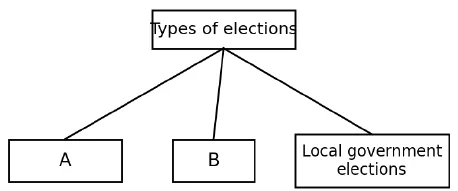
(a) A: presidential elections. B: parliamentary elections.
(b) A councillor (also the mayor or council chairperson).
(c) The Electoral Process Act No. 35 of 2016.
(d) A by-election is held between general elections to fill a seat left vacant by the death, resignation or expulsion of an MP or councillor.
(e) At this stage Parliament makes or amends laws, such as the Constitution and the Electoral Process Act, that set the rules for how elections are conducted.
Question 2
Explain these concepts in relation to culture: (a) cultural beliefs, (b) traditions, (c) rites of passage, (d) cultural heritage. [2 each]
(a) Cultural beliefs are ideas that a group of people accept as true, for example about God, ancestors, life and death, and which guide how they live.
(b) Traditions are customs and ways of doing things passed from one generation to the next, for example traditional ceremonies such as the Kuomboka.
(c) Rites of passage are ceremonies that mark a person’s move from one stage of life to another: birth, initiation into adulthood, marriage and death.
(d) Cultural heritage is the legacy of physical items and non-physical features (monuments, artefacts, language, music and customs) inherited from past generations and preserved for future ones.
Question 3
(a) State two services a customer can access at a bank agent or makeshift booth. [2]
(b) Give two benefits of using a bank agent. [2]
(c) Explain (i) current accounts, (ii) deposit accounts. [4]
(a) Cash deposits and withdrawals; money transfers and bill payments.
(b) It saves time and transport costs because agents are near home; it avoids long queues and is open beyond banking hours.
(c)(i) Current accounts are demand deposits, used mostly by businesses. Money can be withdrawn at any time by cheque, usually no interest is paid, and overdrafts may be given.
(c)(ii) Deposit accounts are savings or fixed (time) deposits on which the bank pays interest. Money is kept for a period, and notice is usually required before withdrawal.
Question 4
(a) What is child labour? [2]
(b) Explain the two types of child prostitution. [4]
(c) Give two measures the government can take to protect children from child labour. [2]
(a) Work done by children below 18 that is harmful to their health, education and physical or mental development.
(b)
- Forced (commercial) child prostitution: a child is coerced, sold or trafficked by adults who sexually exploit the child for money.
- Voluntary (survival) child prostitution: a child exchanges sex for money, food or shelter because of poverty, being orphaned or living on the street.
(c)
- Enforce laws such as the Children’s Code Act and punish offenders.
- Provide free education and support poor families, for example through the Social Cash Transfer.
Question 5
Study the graph of the actual output of country X, 1970–2020.
(a) In which year was actual output highest? [1] (b) What was the output in 2010? [2]
(c) What is meant by productive capacity? [1]
(d) List two external factors that led to the decline of Zambia’s economy in the mid-1980s. [2]
(e) Name two social security programmes run by the Ministry of Community Development and Social Services. [2]
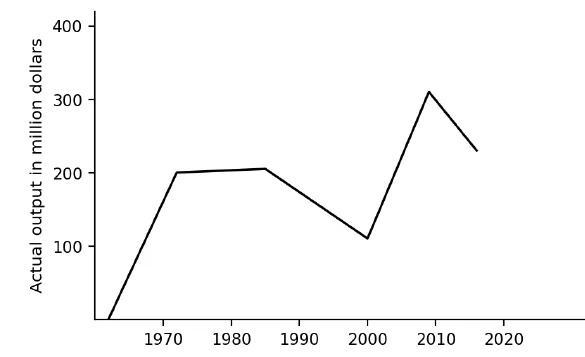
(a) 2010.
(b) About $300 million.
(c) The maximum amount of goods and services an economy can produce using all its available resources.
(d)
- A fall in copper prices on the world market.
- A rise in oil prices and high interest rates on foreign debt.
(e) The Social Cash Transfer scheme and the Food Security Pack programme.
SECTION C: ESSAY QUESTIONS [40 MARKS]
This section consists of five essay questions. Answer any two questions.
Question 1
(a) Describe the process of making and adopting a constitution in Zambia. [12]
(b) Analyse the characteristics of a good constitution. [8]
(a)
- Appointment of a commission: the President appoints a Constitution Review Commission under the Inquiries Act and gives it terms of reference.
- Collection of views: the commission collects submissions from citizens, chiefs, churches, political parties and other groups at public sittings in all provinces and districts.
- Report and draft: the commission analyses the submissions and presents a report and a draft constitution to the President.
- Government White Paper: the government publishes a White Paper showing which recommendations it accepts or rejects.
- Constituent body: the draft is debated by a body representing different groups, such as the National Constitutional Conference.
- Parliament: the Constitution Bill is published in the Government Gazette and goes through first reading, second reading, committee stage and third reading in the National Assembly. It needs the support of at least two-thirds of all members.
- Referendum: changes to the Bill of Rights (Part III) and Article 79 must be approved in a national referendum in which at least half of the registered voters take part.
- Assent: the President signs the Bill and it becomes law, for example the Constitution of Zambia (Amendment) Act No. 2 of 2016, assented to on 5 January 2016.
(b)
- Clarity: written in simple, clear language so it is not misinterpreted.
- Protection of rights: a Bill of Rights protects citizens’ fundamental rights and freedoms.
- Separation of powers: power is divided among the Executive, Legislature and Judiciary, with checks and balances.
- Flexibility: it can be amended as society changes, but not so easily that it becomes unstable.
- Legitimacy: it reflects the will of the people because citizens took part in making it.
- Durability: it lasts a long time and brings political stability.
Question 2
(a) Explain the concept “substance abuse”. [2]
(b) Discuss substances and their effects on the user. [10]
(c) Analyse the effects of substance abuse at national level. [8]
(a) Substance abuse is the use of drugs or substances such as alcohol, tobacco or medicines in excess or for purposes they are not meant for, in a way that harms the user and others.
(b)
- Alcohol (beer, spirits, kachasu): drunkenness, poor judgement, liver cirrhosis, accidents and addiction.
- Tobacco (cigarettes, snuff): nicotine addiction, lung cancer, bronchitis and heart disease.
- Cannabis (marijuana, dagga): hallucinations, memory loss, poor concentration and mental illness.
- Cocaine and heroin: strong addiction, heart failure and death from overdose; sharing needles spreads HIV.
- Inhalants (glue, petrol, jenkem): brain damage, dizziness, suffocation and sudden death.
(c)
- Loss of productive labour: addicts cannot work, reducing national production.
- More crime: abusers steal and commit violence to get money for drugs.
- Higher government spending on health care, rehabilitation centres and law enforcement.
- Spread of HIV/AIDS through risky sexual behaviour.
- Road accidents and a poor national image, with loss of life.
Question 3
(a) Explain the forms of citizen participation in Zambia’s governance system. [6]
(b) Examine factors hindering women’s participation in democratic governance. [14]
(a)
- Voting: citizens aged 18 and above vote in general elections, by-elections and referendums.
- Standing for office: citizens can contest as councillors, members of parliament or president.
- Joining organisations: citizens join political parties, civil society organisations and ward development committees to influence decisions.
(b)
- Cultural beliefs: many traditions see women as home keepers and men as leaders.
- Low levels of education: many women lack the education and skills needed for leadership.
- Lack of finance: women often cannot afford nomination fees and campaign costs.
- Political violence: violence and intimidation during campaigns discourage women.
- Family responsibilities: housework and childcare leave little time for politics.
- Lack of support: some husbands, families and even other women do not support women candidates.
- Party structures: male-dominated parties adopt fewer women as candidates.
Question 4
(a) Describe the concept “marriage”. [4]
(b) Describe the four conditions on which a marriage contract is based. [8]
(c) Analyse four types of marriage that are illegal in Zambia. [8]
(a) Marriage is a legally and socially recognised union between a man and a woman who voluntarily agree to live together as husband and wife. In Zambia it may be a statutory marriage under the Marriage Act or a customary marriage.
(b)
- Consent: both parties must freely agree to marry.
- Capacity (age): both must be 18 or older and of sound mind.
- No legal impediment: they must not be closely related, and neither may already be married under statutory law.
- Formalities: the legal procedures must be followed: notice, licence, registrar and witnesses in a statutory marriage, or payment of lobola in a customary marriage.
(c)
- Child marriage: one or both parties are below 18. It denies children education and harms their health.
- Same-sex marriage: a union between two people of the same sex is not recognised by Zambian law.
- Incestuous marriage: marriage between close relatives, such as a brother and sister, is prohibited.
- Bigamy: marrying another person while still married under the Marriage Act is a criminal offence.
Question 5
(a) Explain the concept “debt relief”. [2]
(b) Explain the two types of loans. [4]
(c) Analyse the causes of debt burden. [14]
(a) Debt relief is the partial or total cancellation, reduction or rescheduling of a country’s debt by its creditors, for example Zambia under the HIPC Initiative in 2005.
(b)
- Soft (concessional) loans: low or no interest, with a long repayment period and a grace period, for example from the World Bank.
- Hard (commercial) loans: high interest and a short repayment period, for example from commercial banks or Eurobonds.
(c)
- Falling export prices: low copper prices reduce the foreign earnings available to repay debts.
- High interest rates increase the amount that must be paid back.
- Mismanagement and corruption: borrowed money is stolen or misused.
- Unproductive projects: loans are spent on projects that do not generate income.
- Depreciation of the kwacha makes foreign debt more expensive in local currency.
- Rising oil prices use up foreign exchange that could repay debt.
- Natural disasters such as droughts and floods force the government to borrow more.
Keep practising
Try another paper under timed conditions, then check your work against the solutions.