SECTION A: WORLD HISTORY FROM 1870–1945 [30 MARKS]
Answer all questions in this section.
Question 1
(a) What is a navy? [2]
(b) Why did Germany want a bigger navy between 1900 and 1914? [2]
(c) How did Britain make sure she had the biggest navy in the world? [2]
(d) Which other European nation had a big navy? [1]
(a) A country’s fleet of warships and sailors, used to defend it and to fight at sea.
(b) To protect her trade and colonies, and to rival Britain as a world power.
(c) She followed the Two-Power Standard (a navy at least as large as the next two navies combined) and, from 1906, built more Dreadnought battleships than Germany.
(d) France (Russia is also accepted).
Question 2
(a) Where was the treaty signed? [1]
(b) Which territories were returned to France? [1] (c) Why were they returned? [1]
(d) What impact did losing the Saar coalfields have on Germany? [1]
(e) What were League of Nations mandates? [1]
(f) Give two mandates that Germany lost in Africa. [2]
(a) The Hall of Mirrors, Palace of Versailles, near Paris.
(b) Alsace and Lorraine.
(c) Germany had taken them from France in the Franco-Prussian War of 1870–71.
(d) Germany lost a major source of coal, which weakened her industry and economy. (The Saar was run by the League of Nations for 15 years, with France taking its coal.)
(e) Former German colonies and Turkish lands placed under the League of Nations and governed on its behalf by Allied powers such as Britain and France until they were ready for self-rule.
(f) Tanganyika (German East Africa) and South West Africa (Namibia). Cameroon and Togoland are also correct.
Question 3
(a) Which country did Mussolini rule from 1922 to 1943? [1]
(b) What was the name of his party when he outlawed all others? [1]
(c) State four economic measures he introduced. [4]
(d) List two territories Mussolini claimed in 1924. [2]
(a) Italy.
(b) The National Fascist Party.
(c)
- The Battle for Grain, to make Italy self-sufficient in wheat.
- Draining the Pontine Marshes to create farmland.
- Public works: motorways (autostrade), hydro-electric schemes and new towns.
- The Corporate State, which organised employers and workers into corporations and banned strikes.
(d) Fiume and Jubaland.
Question 4
Study the bar chart of German spending on armaments, 1935–1940.
(a) What was the percentage when Germany started rearming? [1] (b) In which year was spending highest? [1] (c) What was the increase between 1939 and 1940? [1]
(d) Why did the German leader begin rearming in 1935? [1] (e) State one act of aggression he committed in 1936. [1]
(f) What does Anschluss mean? [1] (g) What was his next target after the Anschluss? [1] (h) What did Germany gain from the Anschluss? [1]
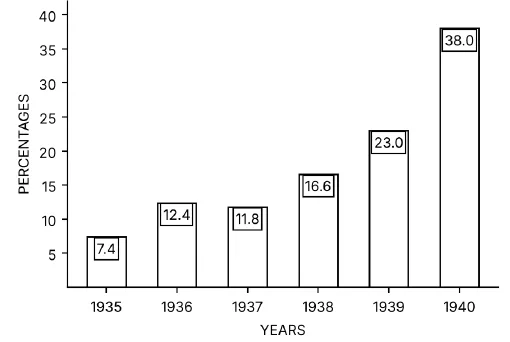
(a) 7.4% (1935).
(b) 1940 (38.0%).
(c) 15 percentage points.
(d) Hitler wanted to destroy the Treaty of Versailles, make Germany strong again and win back lost lands.
(e) He sent German troops into the Rhineland (March 1936), which the treaty had demilitarised.
(f) The union of Austria with Germany (1938).
(g) The Sudetenland in Czechoslovakia.
(h) Union with Austria, gaining its people, army, gold reserves and resources.
SECTION B: WORLD HISTORY FROM 1945 TO PRESENT TIME [30 MARKS]
Answer all questions in this section.
Question 1
A table lists the Secretaries-General from Trygve Lie (A, 1946–1953) through Boutros Boutros-Ghali (B, 1992–1996) and Ban Ki-moon (2007–2016) to C (Portuguese, dates D).
(a) To which organ of the organisation did they belong? [1] (b) State one function of this organ. [1]
(c) Give the nationalities A and B. [2] (d) Name C. [1] (e) Give C’s dates in office. [1]
(f) How many years did Boutros-Ghali serve? [1] (g) Who was the last African to serve? [1] (h) Who died in a plane crash in Zambia? [1]
(a) The Secretariat of the United Nations.
(b) It runs the day-to-day administration of the UN (and carries out the decisions of the other organs).
(c) A: Norwegian. B: Egyptian.
(d) António Guterres.
(e) 2017 to the present.
(f) 5 years (1992–1996), a single term.
(g) Kofi Annan of Ghana.
(h) Dag Hammarskjöld, killed in a plane crash near Ndola in 1961.
Question 2
(a) What was the new constitutional government in Germany after the First World War called? [1]
(b) Who was its first President? [1]
(c) State two measures taken to deal with hyperinflation and unemployment. [2]
(d) What was Hitler’s attempted coup of 1923 called? [1]
(a) The Weimar Republic.
(b) Friedrich Ebert.
(c)
- A new currency, the Rentenmark (1923), replaced the worthless mark.
- The Dawes Plan (1924) reduced reparation payments and brought in American loans.
(d) The Munich (Beer Hall) Putsch.
Question 3
(a) What does NATO stand for? [1] (b) When was it formed? [1] (c) Why was it formed? [1]
(d) Name two countries that joined in 1952. [2] (e) What ideology did its members promote? [1]
(f) Which was the superpower among its members? [1] (g) Which organisation was formed to oppose NATO? [1] (h) What ideology did that organisation promote? [1]
(a) North Atlantic Treaty Organisation.
(b) 4 April 1949.
(c) To defend Western countries against the spread of Soviet communism: an attack on one member is an attack on all.
(d) Greece and Turkey.
(e) Capitalism and democracy.
(f) The United States of America.
(g) The Warsaw Pact (1955).
(h) Communism.
Question 4
(a) Who is Head of the Commonwealth? [1] (b) Where are its headquarters? [1]
(c) State two objectives. [2] (d) What is its policy-making body? [1]
(e) What is a diplomat from one Commonwealth country to another called? [1] (f) What is a country’s chief representative to a non-Commonwealth country called? [1]
(a) King Charles III.
(b) Marlborough House, London.
(c)
- To promote democracy, human rights and the rule of law.
- To promote trade, development and cooperation among members.
(d) The Commonwealth Heads of Government Meeting (CHOGM).
(e) A High Commissioner.
(f) An Ambassador.
SECTION C: WORLD HISTORY FROM 1870 TO 1945 [20 MARKS]
There are four essay questions. Answer only one essay question from this section.
Answer one essay (20 marks):
- Write on the reforms of Emperor Meiji in Japan, 1870–1900: (a) agricultural, (b) industrial, (c) educational, (d) government, (e) military. [4 each]
- (a) Explain the term “Partition of Africa”. [2] (b) Why were African lands colonised after 1885? [18]
- (a) Why did Britain follow a policy of “Splendid Isolation” in the second half of the 19th century? [10] (b) Explain why she eventually abandoned it. [10]
- (a) Explain the challenges of the Weimar Republic. [10] (b) How did Hitler take advantage of these challenges to rise to power? [10]
Question 4: model answer
(a) The challenges of the Weimar Republic
- The Republic was blamed for signing the hated Treaty of Versailles. Its leaders were called the “November criminals” who had “stabbed Germany in the back”.
- The treaty was harsh: Germany lost land, her army was cut to 100 000 men, and she had to pay reparations of £6 600 million.
- The constitution was weak. Proportional representation produced many small parties and unstable coalition governments, and Article 48 allowed the President to rule by decree.
- There were uprisings from the left and the right: the Spartacist Revolt (1919), the Kapp Putsch (1920) and the Munich Putsch (1923), and political murders such as that of Walter Rathenau.
- When Germany failed to pay reparations, France and Belgium occupied the Ruhr (1923), Germany’s main industrial area.
- Hyperinflation in 1923 made the mark worthless and wiped out the savings of the middle class.
- The Great Depression (1929) ended American loans; about 6 million people were unemployed by 1932.
- Many army officers, judges and civil servants were still loyal to the Kaiser and did not support democracy.
(b) How Hitler took advantage of these challenges
- He promised to tear up the Treaty of Versailles and make Germany great again, which pleased angry nationalists.
- During the Depression he promised “work and bread” to the millions of unemployed.
- He blamed the Jews and the communists for Germany’s problems, giving people someone to blame.
- Fear of communism won him money and support from industrialists, farmers and the middle class.
- Goebbels’ propaganda, mass rallies, posters, radio and Hitler’s powerful speeches spread the Nazi message.
- The SA (stormtroopers) broke up opponents’ meetings and frightened voters.
- Weak coalitions and rule by Article 48 made democracy look useless. In July 1932 the Nazis became the largest party in the Reichstag, with 230 seats.
- Von Papen and President Hindenburg made him Chancellor in January 1933, believing they could control him.
- He used the Reichstag Fire (February 1933) to arrest communists, and the Enabling Act (March 1933) to make laws without the Reichstag.
- When Hindenburg died in August 1934, he combined the posts of President and Chancellor and became Führer (dictator).
Questions 1, 2 and 3: answer plans
- Question 1 (Meiji reforms): Agricultural: land tax in money, peasants allowed to own land. Industrial: government-built railways, factories and telegraphs, later sold to private firms (zaibatsu). Educational: compulsory primary education (1872), universities, students sent abroad. Government: feudal domains abolished and replaced by prefectures (1871), the 1889 constitution and the Diet. Military: conscription (1873), a modern army trained on German lines and a navy on British lines; the samurai lost their privileges. Give four points for each heading, as each is worth 4 marks.
- Question 2 (Partition of Africa): (a) Define it as the division of Africa among European powers, formalised at the Berlin Conference (1884–85). (b) Explain the reasons, each in its own paragraph: raw materials, markets for manufactured goods, investment of surplus capital, prestige and nationalism, strategic bases (Suez, the Cape), missionary work and the “civilising mission”, explorers’ reports, rivalry between European powers, settlement for surplus population, and the end of the slave trade. 18 marks means about nine well-explained points.
- Question 3 (Splendid Isolation): (a) Britain had the world’s strongest navy and a large empire, did not want to be dragged into European wars, wanted to keep a balance of power, and gained most from trade and peace. (b) She abandoned it because of the rise of the German navy and Germany’s ambitions, the lack of allies exposed by the Boer War, fear of Russia in Asia, and colonial rivalry. This led to the Anglo-Japanese Alliance (1902), the Entente Cordiale with France (1904) and the Anglo-Russian Entente (1907).
Keep practising
Try another paper under timed conditions, then check your work against the solutions.