MULTIPLE-CHOICE QUESTIONS [40 MARKS]
Answer all the questions. Each question carries one mark.
Question 1
1 The part of the microscope responsible for reflecting light rays onto the object is the …
A condenser
B mirror
C objective lens
D stage
Answer: B (mirror). The mirror reflects light from the lamp or window up through the condenser and onto the specimen. The condenser focuses the light, the objective lens magnifies, and the stage holds the slide.
Question 2
2 The diagram shows a cell seen under an electron microscope. Which labelled part modifies and carries proteins such as enzymes from the site of synthesis to the site of reaction?
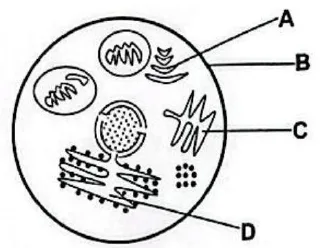
Answer: B (Golgi body). The Golgi body is the stack of flattened sacs. It receives proteins made on the ribosomes of the rough endoplasmic reticulum (D), modifies and packages them into vesicles, and sends them where they are needed.
Question 3
3 Uptake of dissolved mineral salts by root hair cells is an example of …
A active transport
B diffusion
C osmosis
D plasmolysis
Answer: A (active transport). Root hair cells already contain more mineral ions than the soil water, so ions must be moved against the concentration gradient. That needs energy from respiration: active transport. Osmosis is the movement of water only.
Question 4
4 The diagram shows the breakdown of food substance X by enzyme V at pH 2 into substance Y. What are Y and V?
A maltose, amylase
B maltose, maltase
C peptide, pepsin
D peptide, pepsinogen
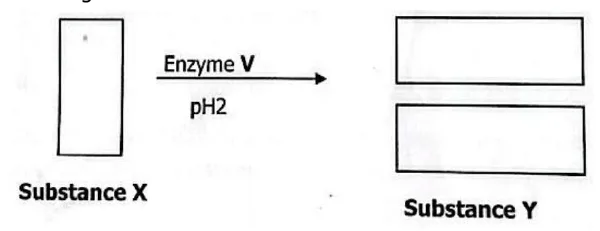
Answer: C (peptide, pepsin). pH 2 is the acid of the stomach, where pepsin breaks proteins into peptides. Amylase works at about pH 7, and pepsinogen is the inactive form of pepsin, not the working enzyme.
Question 5
5 A food sample is mixed with ethanol to dissolve it, then distilled water is added and the colour change is observed. Which food test is this?
A Benedict’s test
B Biuret test
C emulsion test
D iodine test
Answer: C (emulsion test). This is the test for fats. Fat dissolves in ethanol; when water is added, the fat comes out as tiny droplets and the mixture turns cloudy white.
Question 6
6 Rickets develops due to a deficiency in nutrition. Which food would be best to prevent rickets?
| Food | Calcium | Iodine | Iron | Vitamin D |
|---|---|---|---|---|
| A | ✓ | ✓ | ✗ | ✗ |
| B | ✓ | ✗ | ✗ | ✓ |
| C | ✗ | ✓ | ✗ | ✓ |
| D | ✗ | ✓ | ✓ | ✗ |
Answer: B (contains calcium and vitamin D). Rickets is soft, weak bones. Bones need calcium, and vitamin D is needed to absorb calcium from the gut, so the best food contains both.
Question 7
7 Which group of people needs more energy-giving foods in their diet?
A aged
B manual worker
C pre-school children
D sick people
Answer: B (manual worker). Hard physical work uses the most energy, so manual workers need more carbohydrates and fats than the other groups.
Question 8
8 Which component of a balanced diet acts as a medium for biochemical reactions in living cells?
A dietary fibre
B mineral salts
C vitamins
D water
Answer: D (water). Chemical reactions in cells take place in solution, and water is the solvent in the cytoplasm.
Question 9
9 The diagram shows the external structure of a leaf. Which labelled part increases light absorption for photosynthesis?
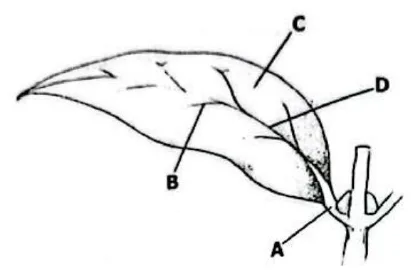
Answer: B (lamina, the leaf blade). The lamina is broad and thin, giving a large surface area to absorb light.
Question 10
10 Identify the tooth in the diagram and its function.
A canine, tearing
B incisor, biting off pieces
C molar, grinding and crushing
D premolar, grinding and crushing
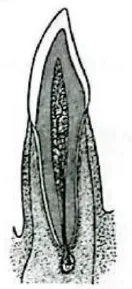
Answer: A (canine, used for tearing). The tooth has one pointed cusp and one long root, the shape of a canine. Incisors are chisel-shaped; molars and premolars have broad, ridged surfaces.
Question 11
11 Which of the following food nutrients is an end product of digestion?
A amino acids
B cellulose
C fats
D proteins
Answer: A (amino acids). Proteins are digested to amino acids, which are small enough to be absorbed. Fats and proteins are the starting molecules, and humans cannot digest cellulose.
Question 12
12 Between which parts of an insect does gaseous exchange occur?
A blood and spiracles
B blood and trachea
C tissue and spiracles
D tissue and trachea
Answer: D (tissue and trachea). Air enters through the spiracles and travels down tracheae (and fine tracheoles) straight to the tissues. Insect blood does not carry oxygen, so exchange is directly between the tracheae and the tissues.
Question 13
13 Which substance in cigarette smoke is addictive?
A carbon monoxide
B nicotine
C sulphur dioxide
D tar
Answer: B (nicotine). Carbon monoxide reduces oxygen transport, and tar causes cancer, but nicotine is the addictive drug.
Question 14
14 Which of the following is the correct equation for anaerobic respiration in man?
A Glucose → carbon dioxide + water + energy
B Glucose → ethanol + carbon dioxide + energy
C Glucose → ethanol + energy
D Glucose → lactic acid + energy
Answer: D (glucose → lactic acid + energy). Human muscles short of oxygen make lactic acid. Option B (ethanol + carbon dioxide) is anaerobic respiration in yeast, and option A is aerobic respiration.
Question 15
15 Why is it important to determine the Rhesus factor of a pregnant woman?
A organ transplant
B blood transfusion
C to prevent haemolytic disease in the foetus
D to prevent HIV transmission
Answer: C. If a Rhesus-negative mother carries a Rhesus-positive baby, she can make antibodies that destroy the red blood cells of a later Rhesus-positive baby (haemolytic disease of the newborn). Knowing her Rhesus factor lets doctors prevent this.
Question 16
16 Jane, whose blood group is B, needs a transfusion. From which blood groups can she receive blood?
A A and B only
B AB and O only
C A, B and AB only
D B and O only
Answer: D (B and O only). Group B blood contains anti-A antibodies, so it would clump any blood carrying antigen A (groups A and AB). Group O has no antigens, so it is safe.
Question 17
17 The diagram shows the relationship between blood, lymph and tissue fluid. Identify the structure labelled P.
A Blood capillary
B Blood cells
C Lacteals
D Lymphatic vessel
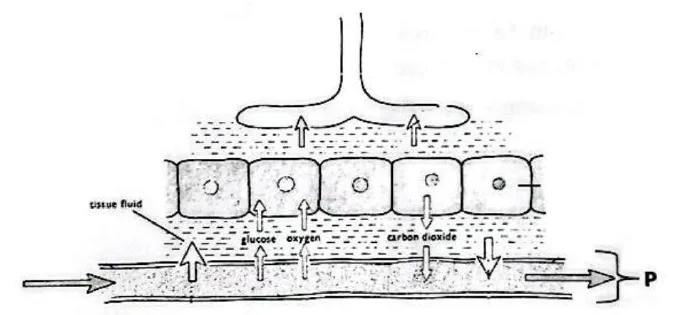
Answer: A (blood capillary). P is the vessel along the bottom from which glucose and oxygen pass out into the tissue fluid, and into which carbon dioxide passes: a blood capillary. The vessel at the top that collects excess tissue fluid is the lymphatic vessel.
Question 18
18 On a cold day, learners in a class started shivering. Which correctly explains this?
A over-cooling leading to heat gain
B over-cooling leading to heat loss
C vasoconstriction leading to heat loss
D vasodilation leading to heat loss
Answer: A. When the body over-cools, muscles contract and relax rapidly (shivering). This releases heat from respiration, so the body gains heat. Vasoconstriction reduces heat loss, so C is wrong.
Question 19
19 The diagram shows the structure of a kidney. What is part X?
A cortex
B medulla
C pelvis
D ureter
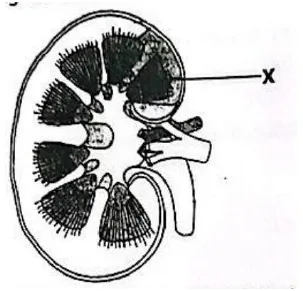
Answer: B (medulla). X points to the dark, striped, cone-shaped pyramids, which make up the medulla. The cortex is the thin outer layer, and the pelvis is the space where urine collects before the ureter.
Question 20
20 Which results from increased secretion of adrenaline?
A decreased breathing rate
B decreased sweating
C increased blood supply to the intestines
D increased supply of glucose in the blood
Answer: D. Adrenaline prepares the body for “fight or flight”: the liver releases glucose into the blood for extra respiration in muscles. It increases breathing rate and diverts blood away from the intestines.
Question 21
21 Which is an example of a spinal reflex?
A blinking
B coughing
C knee jerk
D sneezing
Answer: C (knee jerk). The knee-jerk reflex arc passes through the spinal cord. Blinking, coughing and sneezing are cranial reflexes controlled by the brain.
Question 22
22 Which of the following identifies the path taken by a ray of light for an image to be formed on the retina?
A Cornea → lens → pupil → retina
B Cornea → pupil → lens → retina
C Lens → cornea → pupil → retina
D Pupil → cornea → lens → retina
Answer: B (cornea → pupil → lens → retina). Light enters through the transparent cornea, passes through the pupil (the hole in the iris), is focused by the lens and lands on the retina.
Question 23
23 In which labelled part of the long bone is red bone marrow found?
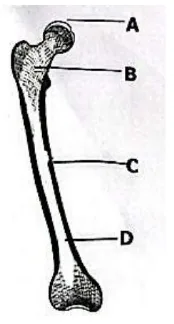
Answer: B (spongy bone at the end of the bone). Red marrow, which makes blood cells, fills the spaces in the spongy bone at the ends. A is cartilage, and the hollow shaft holds yellow (fatty) marrow.
Question 24
24 The diagram shows the effect of auxin on a root placed horizontally. Which best describes the result?
A less on X, promotes elongation
B less on Y, promotes elongation
C more on X, retards elongation
D more on Y, retards elongation

Answer: C (more auxin on X, retards cell elongation). Gravity makes auxin collect on the lower side (X). In roots, high auxin concentration slows elongation, so the upper side (Y) grows faster and the root bends down. In shoots the effect is the opposite.
Question 25
25 In which labelled region of the root tip will there be most cell division?
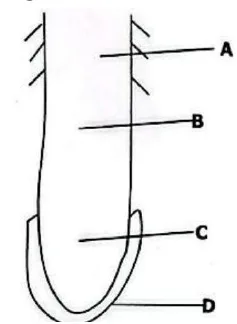
Answer: C (region of cell division, the meristem). It lies just behind the root cap (D). B is the region of elongation and A is the region of differentiation, where root hairs appear.
Question 26
26 What type of reproduction takes place in Rhizopus?
A binary fission
B budding
C fragmentation
D spore formation
Answer: D (spore formation). Rhizopus (bread mould) produces spores in sporangia. Binary fission is typical of bacteria, and budding of yeast.
Question 27
27 Which of the following adaptive structures are for a wind-pollinated flower?
A Brightly coloured petals, large anthers and long filaments
B Brightly coloured petals, small anthers and short filaments
C Dull coloured petals, large anthers and long filaments
D Dull coloured petals, small anthers and short filaments
Answer: C (dull coloured petals, large anthers and long filaments). Wind flowers do not need to attract insects, so petals are small and dull. Long filaments hold large anthers outside the flower so the wind can carry away lots of pollen.
Question 28
28 Which parts form the female part of the flower?
A P, Q, R
B T, S, R
C T, U, S
D U, P, T
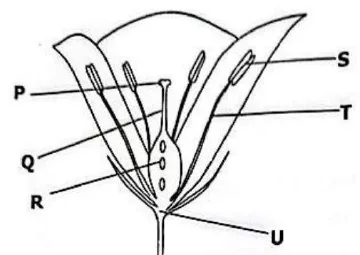
Answer: A (P, Q, R). The carpel is made of the stigma (P), style (Q) and ovary (R). S is an anther and T a filament, the male parts.
Question 29
29 How are the seeds of the following plants dispersed?
| N | O | P | |
|---|---|---|---|
| A | Animal | Self | Wind |
| B | Animal | Wind | Self |
| C | Self | Animal | Wind |
| D | Self | Wind | Animal |
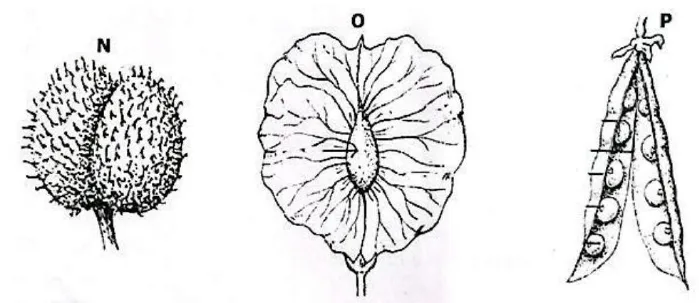
Answer: B (N animal, O wind, P self). N has hooks that catch on fur; O has a light papery wing carried by wind; P is a pod that dries and splits open, throwing out its seeds (self-dispersal).
Question 30
30 Which hormones stimulate the secretion of oestrogen and progesterone during the menstrual cycle?
A Adrenaline and luteinising hormone
B Antidiuretic hormone and follicle-stimulating hormone
C Antidiuretic hormone and luteinising hormone
D Follicle-stimulating hormone and luteinising hormone
Answer: D (follicle-stimulating hormone and luteinising hormone). Both come from the pituitary gland: FSH stimulates the follicle to make oestrogen, and LH causes ovulation and stimulates the corpus luteum to make progesterone. ADH controls water balance, not the menstrual cycle.
Question 31
31 Which one is not a health risk associated with foetal development?
A alcohol and drugs
B antenatal services
C poor nutrition
D smoking
Answer: B (antenatal services). Antenatal care protects the mother and baby; the other three can harm the developing foetus.
Question 32
32 Which is not a possible risk of using contraceptives?
A disturbed menstrual cycle
B hormonal imbalance
C planned families
D weight gain
Answer: C (planned families). Planning a family is a benefit of contraception, not a risk.
Question 33
33 What stage of mitosis is illustrated in the diagram?
A Anaphase
B Prophase
C Telophase
D Metaphase
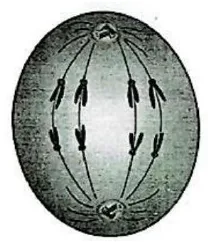
Answer: A (anaphase). The spindle fibres are pulling chromatids apart towards opposite poles. In metaphase the chromosomes would be lined up across the middle.
Question 34
34 Which statement about sperm cells is correct? They contain …
A either one X or one Y chromosome
B one X and one Y chromosome
C one X chromosome
D one Y chromosome
Answer: A. A man’s body cells are XY. Meiosis separates the pair, so half his sperm carry an X and half carry a Y. This is why the father’s sperm decides the sex of the baby.
Question 35
35 Which phylum has organisms with three pairs of legs?
A Annelida
B Arthropoda
C Mollusca
D Porifera
Answer: B (Arthropoda). Insects, which have three pairs of jointed legs, belong to the phylum Arthropoda.
Question 36
36 In which type of soil will a plant tolerant to acid and waterlogging grow well?
A clay
B limestone
C loam
D sandy
Answer: A (clay soil). Clay has tiny particles and small air spaces, so it drains poorly and becomes waterlogged. Limestone soils are alkaline, and sandy soils drain quickly.
Question 37
37 What do we call a group of organisms of different species living in the same area and interacting with each other?
A community
B habitat
C niche
D population
Answer: A (community). A population is one species; a community is all the populations of different species in an area.
Question 38
38 The diagram shows a food web. Which organisms in the food web are producers?
A Field mouse, dandelion and grass
B Grass, wheat and dandelion
C Rabbit, dandelion and field mouse
D Wheat, rabbit and field mouse
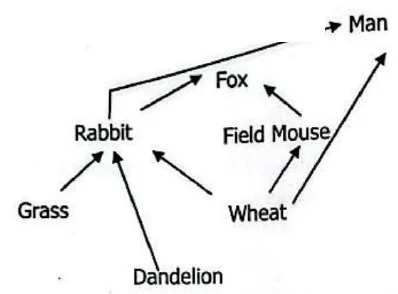
Answer: B (grass, wheat and dandelion). Producers are green plants that make food by photosynthesis. Arrows point away from them, and nothing points into them.
Question 39
39 The diagram shows the carbon cycle. Identify the processes marked X, Y and Z.
| X | Y | Z | |
|---|---|---|---|
| A | Photosynthesis | Combustion | Decomposition |
| B | Photosynthesis | Respiration | Decomposition |
| C | Respiration | Photosynthesis | Fossilisation |
| D | Respiration | Respiration | Fossilisation |
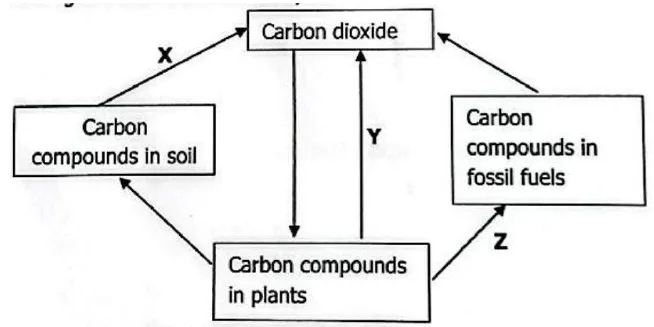
Answer: D (X respiration, Y respiration, Z fossilisation). X: decomposers in the soil respire, releasing CO₂. Y: plants also respire, releasing CO₂ (the downward arrow is photosynthesis). Z: buried plant remains slowly become fossil fuels.
Question 40
40 Which will contribute to land pollution?
A dead plant remains
B mineral elements
C non-biodegradable materials
D soil micro-organisms
Answer: C (non-biodegradable materials). Plastics and similar materials cannot be broken down by decomposers, so they build up on land. Dead plant remains rot and return nutrients to the soil.
Keep practising
Try another paper under timed conditions, then check your work against the solutions.