SECTION A [20 MARKS]
Answer all the questions in this section.
A1
A1 What is the reading on the vernier caliper?
A 2.30 cm
B 2.35 cm
C 2.38 cm
D 2.39 cm
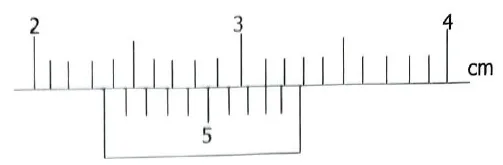
Answer: C (2.38 cm). The vernier zero lies just past 2.3 cm on the main scale. The 8th vernier line lines up exactly with a main-scale line, so add 0.08 cm: 2.30 + 0.08 = 2.38 cm.
A2
A2 The speed-time graph shows a car’s movement over 50 s. What distance did the car cover while its speed was increasing and decreasing?
A 200 m
B 150 m
C 100 m
D 50 m
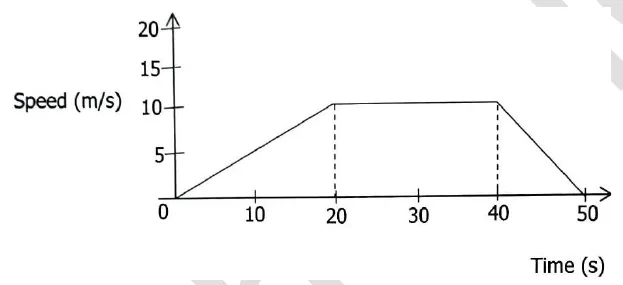
Answer: B (150 m). Distance is the area under the graph. Speeding up: m. Slowing down: m. Total 150 m (the constant-speed part is not included).
A3
A3 A train slows from 9 m/s to 5 m/s in 10 s. How far does it move while slowing down?
A 40 m
B 50 m
C 70 m
D 110 m
Answer: C (70 m). For uniform deceleration, distance = average speed × time m.
A4
A4 A metre rule is pivoted at its centre. A 100 g mass hangs 40 cm from the pivot and mass M hangs at the 0 cm mark. What is M?
A 20 g
B 50 g
C 80 g
D 100 g
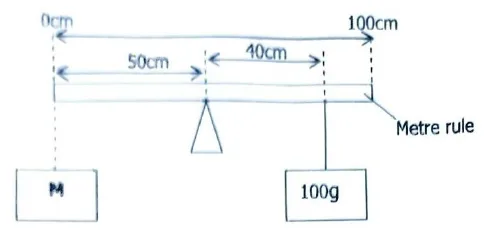
Answer: C (80 g). M is 50 cm from the pivot. Clockwise moments = anticlockwise moments: , so g.
A5
A5 A learner of mass 20 kg reaches 6.0 m/s at the bottom of a slide. What is her kinetic energy?
A 120 J
B 200 J
C 360 J
D 720 J
Answer: C (360 J). J. (720 J is what you get if you forget the ½.)
A6
A6 A metal rod is heated at one end by a flame. By what process or processes does heat reach the hand holding the rod?
A conduction
B conduction and convection
C conduction and radiation
D radiation only
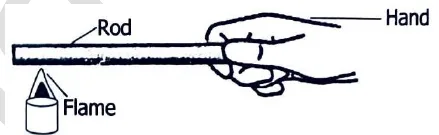
Answer: C (conduction and radiation). Most of the heat travels along the metal rod by conduction. The hand is also close enough to the flame to receive heat directly by radiation, which needs no medium. Some marking schemes accept A (conduction) alone, because conduction through the rod is the main route.
A7
A7 Which of the following statements is not true? Absolute zero is …
A equal to zero kelvin on the absolute temperature scale.
B equivalent to −273 °C on the absolute temperature scale.
C represented by °C.
D the lowest possible temperature at which the volume of a gas is assumed to be zero.
Answer: C. Absolute zero is written as 0 K on the kelvin scale, not with the °C symbol, so statement C is the one that is not true. Statements A, B and D all describe absolute zero correctly: it is 0 K, equivalent to about −273 °C, and it is the temperature at which the volume of an ideal gas would theoretically shrink to zero.
A8
A8 A wave source of frequency 500 Hz emits waves of wavelength 0.05 m. How long do the waves take to travel 1 250 m?
A 5 s
B 8 s
C 50 s
D 200 s
Answer: C (50 s). Wave speed m/s, so time s.
A9
A9 Calculate the frequency of red light of wavelength m.
A Hz
B Hz
C Hz
D Hz
Answer: B. Light travels at m/s, so
A10
A10 A ship’s siren is reflected by a cliff and heard 6.0 s later. How far is the ship from the cliff? (Speed of sound = 330 m/s.)
A 53 m
B 160 m
C 990 m
D 1 920 m
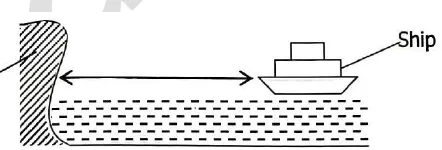
Answer: C (990 m). In 6.0 s the sound travels m, which is there and back. The distance to the cliff is half: 990 m.
A11
A11 Which is not a characteristic of an image formed by a plane mirror?
A diminished
B same size as object
C upright
D virtual
Answer: A (diminished). A plane mirror gives an image that is the same size, upright, virtual and laterally inverted. It is never smaller.
A12
A12 Light passes from water (speed m/s) into glass (speed m/s). The angle of refraction is 30°. Calculate the angle of incidence .
A 1.2°
B 2.3°
C 30.0°
D 34.4°
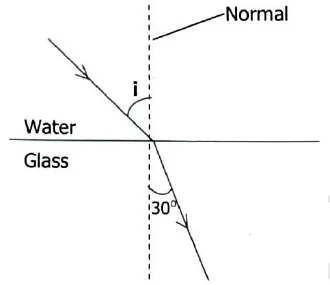
Answer: D (34.4°). The ratio of the sines equals the ratio of the speeds:
The light slows down entering the glass, so it bends towards the normal and must be bigger than 30°.
A13
A13 A coil is wound around a U-shaped core AB and connected to a battery. What are the polarities of A and B when the switch is closed?
A A north, B south
B both south
C A south, B north
D both north
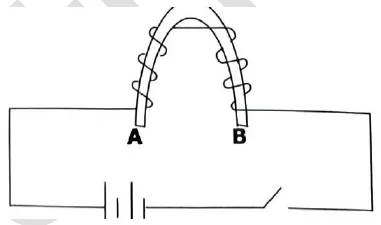
Answer: A (A north, B south). The two ends of a U-shaped electromagnet are always opposite poles, which rules out B and D. Using the right-hand grip rule on the direction of the current in the windings shows that A is north and B is south.
A14
A14 A positively charged insulated metal sphere is brought close to, but does not touch, an uncharged insulated metal sphere. Which diagram shows the correct charge distribution?
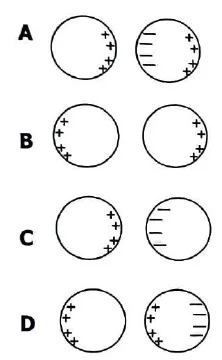
Answer: A. The positive charge attracts electrons in the uncharged sphere to its near side (negative), leaving its far side positive. This is charging by induction, and the uncharged sphere stays neutral overall.
A15
A15 A 12 V battery is connected to a 6 Ω resistor. How much charge flows through the resistor in 40 s?
A 80 C
B 136 C
C 160 C
D 240 C
Answer: A (80 C). A, then C.
A16
A16 A heater is rated 2.5 kW at 250 V. What is the resistance of the wire?
A 10 Ω
B 15 Ω
C 20 Ω
D 25 Ω
Answer: D (25 Ω). , so Ω. Remember to change 2.5 kW to 2 500 W.
A17
A17 The graph shows the p.d. produced by a generator. What are its maximum voltage and frequency?
A 4 V, 0.25 Hz
B 8 V, 4.0 Hz
C 8 V, 0.50 Hz
D 4 V, 4.0 Hz
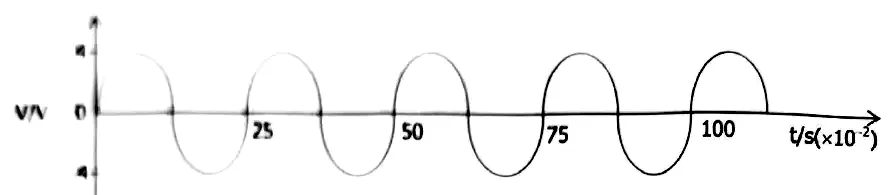
Answer: D (4 V, 4.0 Hz). The peak is 4 V (8 V is peak-to-peak). One complete cycle takes s, so Hz.
A18
A18 The diagram shows a left hand being used to determine the direction of the force when a current-carrying conductor is perpendicular to a magnetic field. Which quantities are represented by the directions of fingers P, Q and R?
| P | Q | R | |
|---|---|---|---|
| A | Current | Field | Force |
| B | Field | Force | Current |
| C | Force | Current | Field |
| D | Force | Field | Current |
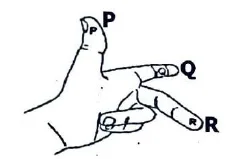
Answer: D (P force, Q field, R current). Fleming’s left-hand rule: thumb = thrust (force or motion), first finger = field, second finger = current.
A19
A19 Which nucleus is produced when americium-241 () emits an alpha particle?
A
B
C
D
Answer: A. An alpha particle is , so the mass number falls by 4 () and the atomic number falls by 2 ().
A20
A20 Which equation shows a fusion reaction?
A
B
C
D
Answer: B. It is the only option in which two light nuclei join together. A and C involve capturing an electron, and D is alpha decay (one nucleus breaking up).
SECTION B [45 MARKS]
Answer all questions in this section.
B1
B1 Complete the table with the quantity each instrument measures and its S.I. unit. [4]
| Instrument | Quantity | S.I. unit |
|---|---|---|
| Voltmeter | Potential difference | Volt (V) |
| Vernier caliper | Length | Metre (m) |
| Thermometer | Temperature | Kelvin (K) |
| Spring balance | Force (weight) | Newton (N) |
B2
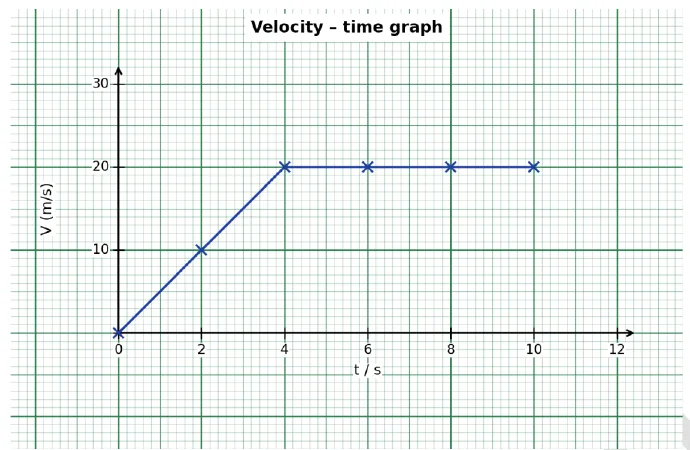
B2 A 2-tonne car starts from rest. Its velocity is 0, 10, 20, 20, 20, 20 m/s at 0, 2, 4, 6, 8, 10 s.
(a) Draw the velocity-time graph. [2] (b) Calculate the acceleration in the first 4 s. [2] (c) Calculate the force giving this acceleration. [2]
(a)
(b)
(c) Change tonnes to kilograms first: kg. N
B3
B3 Two boys (300 N and 210 N) sit on a see-saw, each 2 m from the pivot on opposite sides. A dog (150 N) is placed at distance X on the same side as the 210 N boy to balance it.
(a) State the principle of moments. [1] (b) Find X. [2] (c) Find the upward force at the pivot. [2]
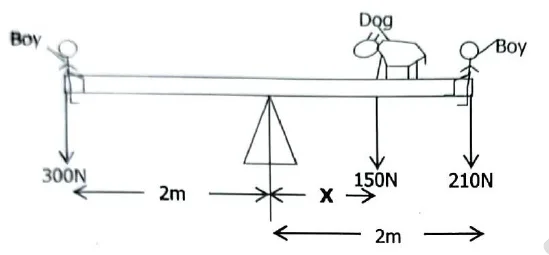
(a) For a body in equilibrium, the sum of the clockwise moments about a point equals the sum of the anticlockwise moments about the same point.
(b)
(c) Upward force = total downward force N
B4
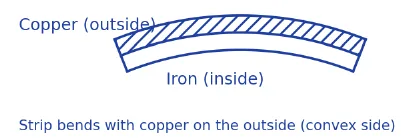
B4 (a) A bimetallic strip is made of copper and iron. Knowing that copper expands more than iron, draw the strip after heating. [1]
(b) A bicycle pump contains 50 cm³ of air at 17 °C and 1.0 atmosphere. Find the pressure when the air is compressed to 10 cm³ and its temperature rises to 27 °C. [2]
(a) The strip bends with copper on the outside (the longer, convex side):
(b) Change temperatures to kelvin: K, K.
B5
B5 A learner stands in the middle of a hall 34 m wide and claps. Echoes are heard after 0.1 s and 0.16 s.
(a) Define a longitudinal wave. [1]
(b) Calculate (i) the speed of sound in air, [2] (ii) the length of the hall. [2]
(a) A wave in which the particles of the medium vibrate parallel to the direction in which the wave travels.
(b)(i) The nearer walls are the side walls, m away. The first echo travels m in 0.1 s:
(b)(ii) Distance to an end wall m. The learner is in the middle, so the length m.
B6
B6 Object A is beyond 2F of a converging lens.
(a) Draw rays to find the image. [1] (b) The image is real. State two other characteristics. [2] (c) Name an optical device that uses a lens to form a real image. [1]
(a) One ray parallel to the axis refracts through F; one ray through the centre of the lens goes straight on. The image forms where they meet, between F and 2F on the other side.
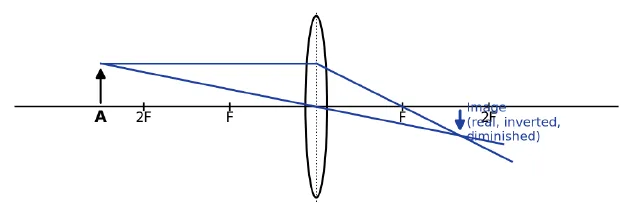
(b) Inverted and diminished (smaller than the object).
(c) A camera (also the eye).
B7
B7 A freely suspended unknown metal bar is brought near a bar magnet, and the magnet moves away.
(a) Identify the type of metal bar. [1] (b) State one possible material. [1]
(c) The bar is replaced by a solenoid on d.c., which also pushes the magnet away. (i) Explain why. [1] (ii) What change would make the magnet move towards the solenoid? [1]
(d) State two changes to the solenoid circuit that would make the magnet move more. [2]
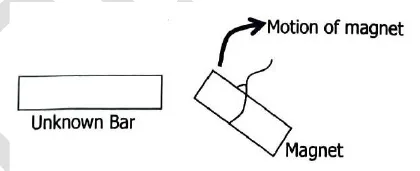
(a) It is a permanent magnet. The magnet was repelled, and only a magnet can repel another magnet; a piece of unmagnetised iron would attract it.
(b) Steel (a magnetically hard material that keeps its magnetism).
(c)(i) The current produces a magnetic field, so the solenoid behaves like a bar magnet. Its near end has the same pole as the near end of the magnet, and like poles repel.
(c)(ii) Reverse the current (swap the connections to the supply), so unlike poles face each other and attract.
(d)
- Increase the current, for example by adding cells to increase the voltage.
- Use a solenoid with more turns.
B8
B8 A battery of e.m.f. 12 V and internal resistance 1 Ω is connected to 2 Ω and 3 Ω resistors in series.
(a) Calculate the total resistance. [2] (b) Find the ammeter reading. [2] (c) Calculate the power lost inside the battery. [2]
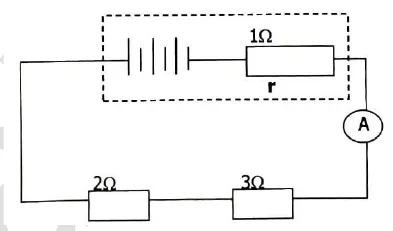
(a) Ω
(b) A
(c) Power lost in the internal resistance: W
B9
B9 (a) Define (i) radioactivity, [1] (ii) nuclear fission. [1]
(b) State one similarity and one difference between nuclear fission and nuclear fusion. [2]
(c) How many protons and neutrons are in ? [2]
(a)(i) Radioactivity is the spontaneous emission of radiation (alpha, beta or gamma) from unstable nuclei.
(a)(ii) Nuclear fission is the splitting of a heavy nucleus into two lighter nuclei, releasing energy.
(b) Similarity: both release a large amount of energy. Difference: fission splits a heavy nucleus, while fusion joins light nuclei into a heavier one.
(c) Protons = atomic number = 1. Neutrons = 2.
SECTION C [20 MARKS]
Answer any two (2) questions from this section.
C1
The table shows load and effort for a simple machine.
| Load (N) | 50 | 100 | 200 | 300 | 400 | 500 | 600 |
|---|---|---|---|---|---|---|---|
| Effort (N) | 35 | 45 | 65 | 85 | 105 | 125 | 145 |
(a) Define a simple machine. [1] (b) Plot load against effort. [4] (c) Determine the slope. [2] (d) What does the gradient represent? [1] (e) Find the efficiency if the velocity ratio is 6. [2]
(a) A device that makes work easier by allowing a small effort to overcome a large load (or by changing the direction of a force).
(b)
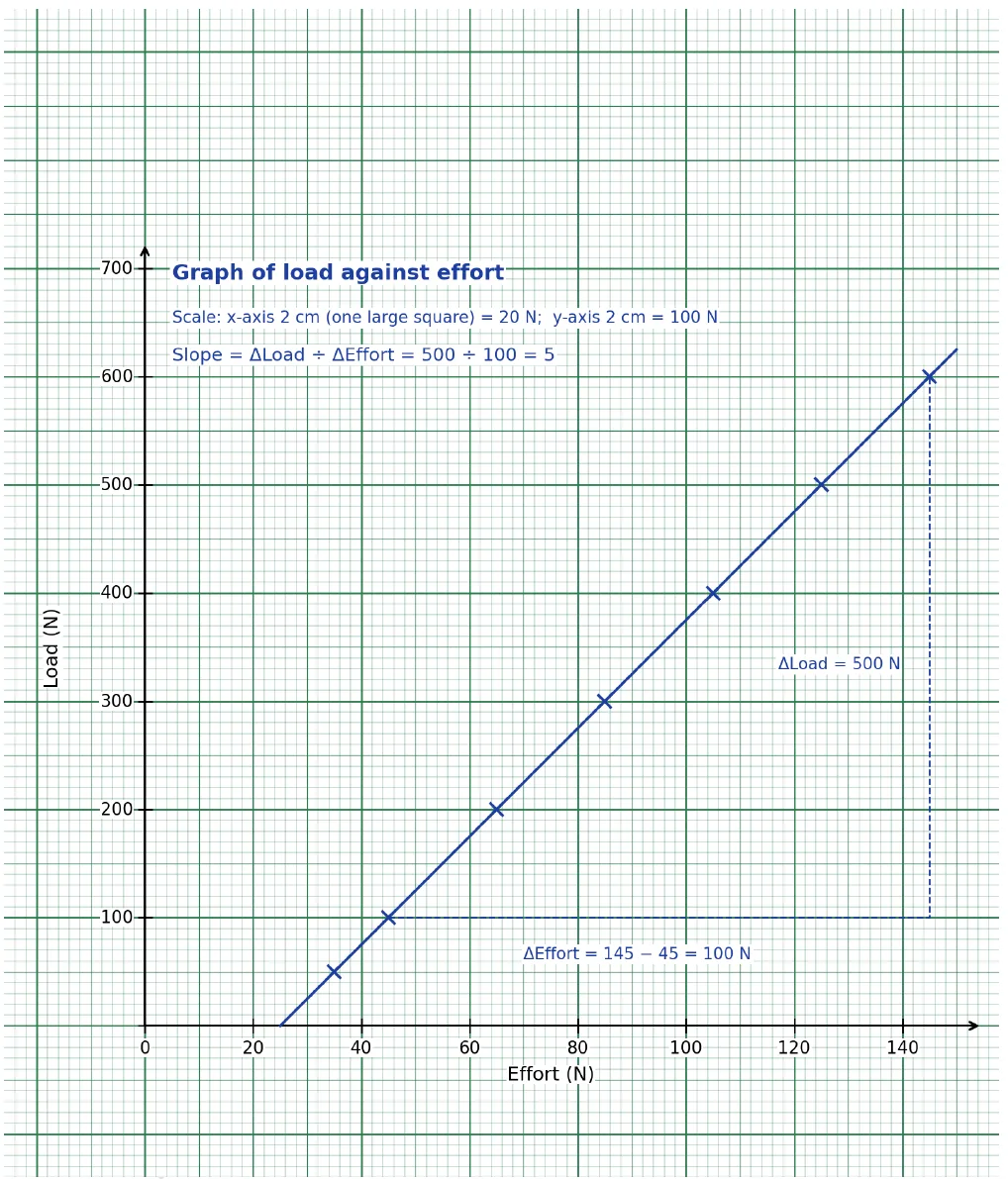
(c) Use two points far apart on the line:
(d) The mechanical advantage (load ÷ effort) of the machine.
(e)
C2
(a) Define (i) work, [1] (ii) energy. [1]
(b) A d.c. motor raises a 1.50 kg load through 0.6 m in 9 s. The voltage is 12.0 V and the current 0.6 A. Taking N/kg, calculate (i) the power input, [2] (ii) the work done raising the load, [2] (iii) the useful power output, [2] (iv) the efficiency. [2]
(a)(i) Work is the product of a force and the distance moved in the direction of the force (), measured in joules.
(a)(ii) Energy is the ability (capacity) to do work, measured in joules.
(b)(i) Power input W
(b)(ii) Work done J
(b)(iii) Useful power output W
(b)(iv) Efficiency
C3
The recorded activity of iodine-128 (including a background count of 5 counts per second) is 81, 62, 49, 38, 30, 24, 19, 16 and 13 disintegrations/s at 0, 10, 20 … 80 minutes.
(a) Complete the row for the activity due to iodine-128 alone. [2] (b) Plot this activity against time. [4] (c) Determine the half-life. [2] (d) How long would the activity take to drop from 1 200 to 75 disintegrations per second? [2]
(a) Subtract the background count (5) from every reading:
| Time (min) | 0 | 10 | 20 | 30 | 40 | 50 | 60 | 70 | 80 |
|---|---|---|---|---|---|---|---|---|---|
| Recorded activity | 81 | 62 | 49 | 38 | 30 | 24 | 19 | 16 | 13 |
| Iodine-128 alone | 76 | 57 | 44 | 33 | 25 | 19 | 14 | 11 | 8 |
(b) and (c)
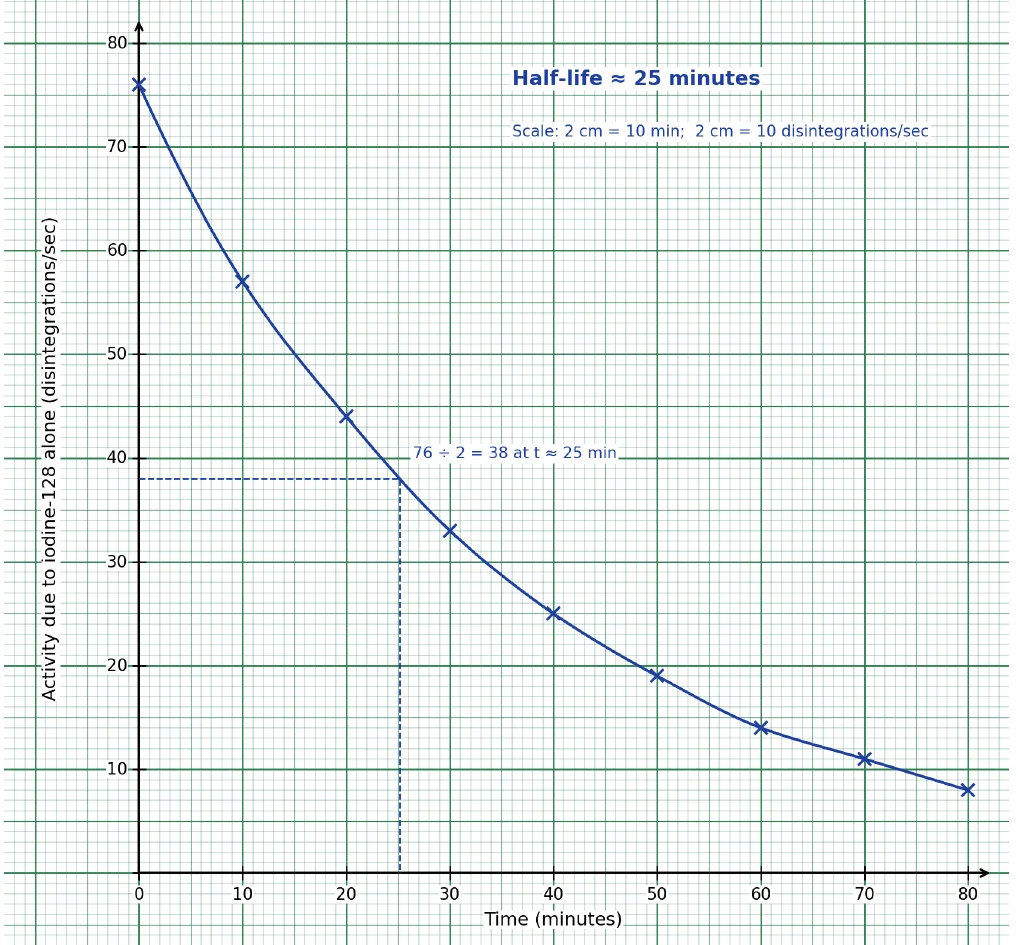
The activity halves from 76 to 38 in about 25 minutes, so the half-life is about 25 minutes.
(d) Count the halvings: is 4 half-lives. Time minutes (answers from about 96 to 104 minutes are accepted, depending on your half-life reading).
Keep practising
Try another paper under timed conditions, then check your work against the solutions.