Step-by-step worked solutions to all 23 questions in the 2026 GCE Mathematics Paper 1 (4024/1), with diagrams, final answers and tips on where marks are lost.
By MathGuideUpdated 24 October 2026Paper 4024/180 marks
Answer all the questions. Write your answers in the spaces provided.
Question 1
Evaluate (6427)31. [2]
A power of 31 means the cube root. Write both numbers as cubes:
(6427)31=(4333)31=43
Answer:43
Question 2
Factorise completely pq−3p−q2+3q. [2]
Group the terms in pairs and take out a common factor from each pair:
pq−3p−q2+3q=p(q−3)−q(q−3)=(q−3)(p−q)
Answer:(q−3)(p−q)
Question 3
Simplify 8x+4−3(2x−3). [2]
8x+4−6x+9=2x+13
Answer:2x+13
Where marks are lost: writing −3(2x−3)=−6x−9. A negative times a negative is positive, so the last term is +9.
Question 4
Solve the equation 2x2−72=0. [2]
2x2=72⇒x2=36⇒x=±6
Answer:x=6 or x=−6
Question 5
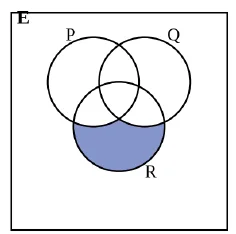
Shade (P∪Q)′∩R on the Venn diagram. [2]
(P∪Q)′ is everything outside both P and Q. Intersecting with R keeps only the part of R that is outside P and Q:
Question 6
The market value of a share is K25.00. How many shares can be bought with K25 250.00? [2]
Number of shares=2525250=1010
Answer: 1 010 shares
Question 7
The first and seventh terms of an arithmetic progression are −11 and 13. Find (a) the common difference d, [1] (b) the nth term. [2]
(a) Cards numbered 1, 2, 3, 4, 5 and 6 are placed in a box. One card is chosen at random. Find the probability that its number is prime. [1] (b) A is the point (1, 1) and AB=(65). Find the coordinates of B. [2]
(a) The primes are 2, 3 and 5 (1 is not prime). P(prime)=63=21
(b)
OB=OA+AB=(11)+(65)=(76)
Answer: (a) 21 (b) B(7, 6)
Question 9
Given A=(3−140) and B=(−13), find (a) AT, [1] (b) AB. [2]
(a) The transpose swaps rows and columns: AT=(34−10)
(b) Multiply each row of A by the column B:
AB=(3(−1)+4(3)−1(−1)+0(3))=(91)
Question 10
(a)R={x:0≤x<10,x is an even number}. List the elements of R. [1] (b) F(−4, 1) is mapped onto G(5, −4) by a translation T. Express T as a column vector. [2]
(a) 0 is included because 0≤x, and 10 is excluded because x<10. Answer:{0,2,4,6,8}
(b) Subtract the starting point from the image:
T=(5−(−4)−4−1)=(9−5)
Question 11
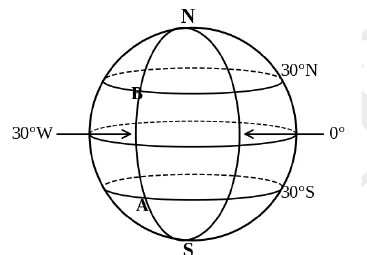
NS is the Prime Meridian. Towns A and B are at (30°S, 30°W) and (30°N, 30°W).
(a) Find the distance between A and B in nautical miles. [1]
(b) If the local time at B is 09 35 hours, what is the local time at the Prime Meridian? [2]
(a) A and B are on the same meridian, one north and one south of the equator, so add the latitudes: 30∘+30∘=60∘. Along a great circle, 1∘=60 nm:
distance=60×60=3600 nm
(b) The difference in longitude is 30∘, and the earth turns 1∘ every 4 minutes:
30×4=120 min=2 h
The Prime Meridian is east of B, so its time is ahead: 0935+2 h=1135.
Answer: (a) 3 600 nm (b) 11 35 hours
Question 12
The absolute error of a number n is 5 and the relative error is 0.2. Find (a) the value of n, [2] (b) the percentage error. [2]
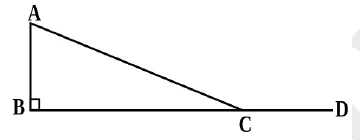
(a) Triangle ABC is right-angled at B, BCD is a straight line and cosAC^D=−1312. Find sinCA^B. [2] (b) Find ∫(x312−3x2)dx. [2]
(a) Angles ACB and ACD lie on a straight line, so cosAC^B=−cosAC^D=1312. In the right-angled triangle this means BC = 12 and AC = 13 (in proportion), and AB=132−122=5.
sinCA^B=hypotenuseopposite=ACBC=1312
(b) Write x312 as 12x−3 first, then integrate each term:
∫(12x−3−3x2)dx=−212x−2−33x3+c=−x26−x3+c
Answer: (a) 1312 (b) −x26−x3+c
Where marks are lost: leaving out ”+ c” in an indefinite integral. It is part of the answer and carries a mark.
Question 14
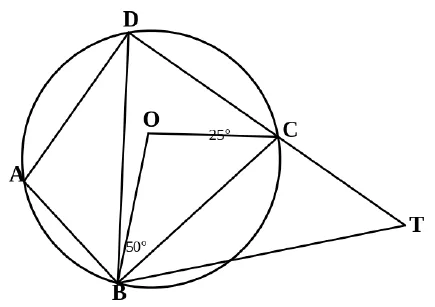
A, B, C and D lie on a circle with centre O. Angle OBC = 50° and angle OCD = 25°. BT is a tangent to the circle at B. Find angle (a) BDC, [1] (b) BAD, [1] (c) BTD. [2]
(a) OB = OC (radii), so triangle OBC is isosceles and angle OCB = 50°. Then angle BOC =180∘−100∘=80∘.
BD^C=21×80∘=40∘(angle at the centre is twice the angle at the circumference)
(b) Angle BCD =50∘+25∘=75∘. ABCD is a cyclic quadrilateral, so opposite angles add up to 180°:
BA^D=180∘−75∘=105∘
(c) Angle CBT = angle BDC = 40° (alternate segment theorem). D, C and T lie on a straight line, so angle BCT =180∘−75∘=105∘. In triangle BCT:
BT^D=180∘−40∘−105∘=35∘
Answer: (a) 40° (b) 105° (c) 35°
Where marks are lost: giving the angle without the reason. In circle-theorem questions, write the theorem name next to each step.
Question 15
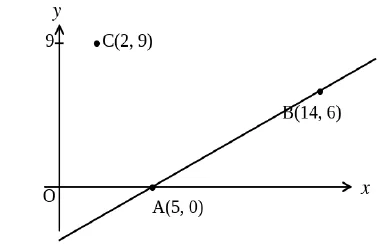
(a) Buckets A and B are geometrically similar. Bucket A is 20 cm high and bucket B is y cm high. Their volumes are 1 000 cm³ and 8 000 cm³. Find y. [2] (b) A straight line passes through A(5, 0) and B(14, 6). C is the point (2, 9). Find the equation of the line perpendicular to AB that passes through C. [2]
(a) For similar solids, the volume ratio is the cube of the length ratio:
(20y)3=10008000=8⇒20y=38=2⇒y=40
(b) Gradient of AB =14−56−0=32. Perpendicular gradients multiply to −1, so the new gradient is −23.
y−9=−23(x−2)⇒y=−23x+12
Answer: (a) y=40 (b) y=−23x+12
Question 16
p varies as q and inversely as the square of r, and p=6 when q=18 and r=3. Find (a) the constant of variation k, [1] (b) q when p=9 and r=5, [1] (c) r when p=3 and q=25. [2]
p=r2kq
(a)6=918k=2k⇒k=3
(b)9=253q⇒3q=225⇒q=75
(c)3=r23(25)⇒3r2=75⇒r2=25⇒r=±5
Answer: (a) k=3 (b) q=75 (c) r=5 or r=−5
Question 17
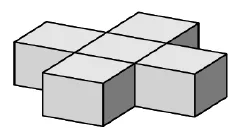
(a) A figure is made up of five identical cubes in a plus shape. State the number of planes of symmetry. [2] (b) Complete the pseudocode for calculating the volume v of a cylinder from its height h and radius r, where v=πr2h. [2]
(a) The plus shape has 4 vertical planes of symmetry (front-to-back, left-to-right and the two diagonals) and 1 horizontal plane through the middle of the layer of cubes.
Answer: 5 planes of symmetry
(b)
Start Enter h, r v = π × r × r × h Output vStop
Question 18
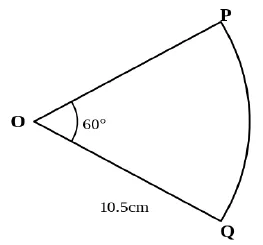
(a) A sector of a circle has centre O, radius 10.5 cm and angle POQ = 60°. Taking π=722, find the area of the sector. [2] (b) P and Q are the points (3, 6) and (−9, 4). Find the coordinates of the midpoint of PQ. [2]
(a)
Area=36060×722×10.5×10.5=57.75 cm2
(b)
(23+(−9),26+4)=(−3,5)
Answer: (a) 57.75 cm² (b) (−3, 5)
Question 19
Given f(x)=x−92 and g(x)=x+5, find (a) f−1(x), [1] (b) fg(x), [1] (c) the value of x for which fg(x)=1. [2]
(a) Let y=x−92 and make x the subject:
y(x−9)=2⇒xy=2+9y⇒x=y2+9y
So f−1(x)=x2+9x.
(b)fg(x) means “do g first, then f”: replace x in f with x+5.
fg(x)=(x+5)−92=x−42
(c)x−42=1⇒x−4=2⇒x=6
Question 20
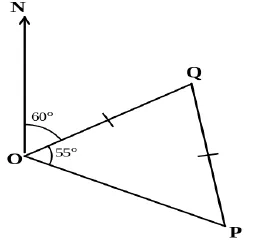
Angle POQ = 55°, OQ = QP and the bearing of Q from O is 060°. Find the bearing of (a) O from Q, [2] (b) P from Q. [2]
(a) A back bearing differs by 180°: 060∘+180∘=240∘.
(b) OQ = QP, so triangle OQP is isosceles and angle QPO = angle QOP = 55°. Then angle OQP =180∘−55∘−55∘=70∘. From Q, P is 70° anticlockwise from the direction of O:
240∘−70∘=170∘
Answer: (a) 240° (b) 170°
Question 21
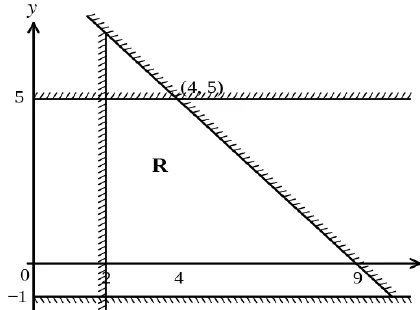
Write the four inequalities that define the unshaded region R. [5]
The vertical line x=2, with R to the right: x≥2
The horizontal line y=−1, with R above it: y≥−1
The horizontal line y=5, with R below it: y≤5
The sloping line through (4, 5) and (9, 0): gradient =9−40−5=−1, and it cuts the y-axis at 9, so y=−x+9, that is x+y=9. R is below it: x+y≤9
Answer:x≥2,y≥−1,y≤5,x+y≤9
Where marks are lost: getting the inequality sign the wrong way round. Test a point inside R, for example (3, 1): 3+1=4≤9 ✓.
Question 22
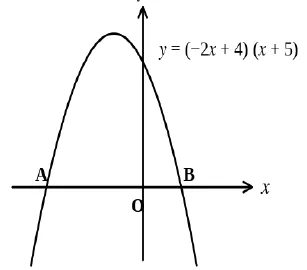
(a) Solve 43x=8. [2] (b) The sketch shows the graph of y=(−2x+4)(x+5), which cuts the x-axis at A and B. Find (i) the coordinates of A and B, [2] (ii) the maximum value of y. [2]
(a) Write both sides as powers of 2:
(22)3x=23⇒26x=23⇒6x=3⇒x=21
(b)(i) At A and B, y=0: −2x+4=0 or x+5=0, so x=2 or x=−5. Answer: A(−5, 0), B(2, 0)
(ii) Expand: y=−2x2−10x+4x+20=−2x2−6x+20. The turning point is at
x=−2ab=−2(−2)−6=−23
(halfway between −5 and 2). Substitute:
y=−2(49)−6(−23)+20=−4.5+9+20=24.5
Answer: maximum value of y is 24.5
Question 23
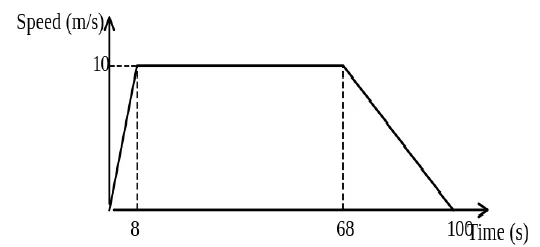
A particle starts from rest, accelerates uniformly to 10 m/s in 8 seconds, travels at constant speed for 60 seconds, then decelerates uniformly to rest in a further 32 seconds. Find (a) the acceleration in the first 8 seconds, [1] (b) the total distance covered, [2] (c) the speed at t=84 seconds. [3]
(a)a=tv−u=810−0=1.25 m/s2
(b) Distance = area under the graph. The shape is a trapezium with parallel sides 60 s and 100 s and height 10 m/s:
21(60+100)×10=800 m
(c) The deceleration lasts 100−68=32 s, so a=−3210=−165 m/s2. At t=84 s the particle has been slowing down for 84−68=16 s:
v=u+at=10−165(16)=5 m/s
Answer: (a) 1.25 m/s² (b) 800 m (c) 5 m/s
Keep practising
Try another paper under timed conditions, then check your work against the solutions.